
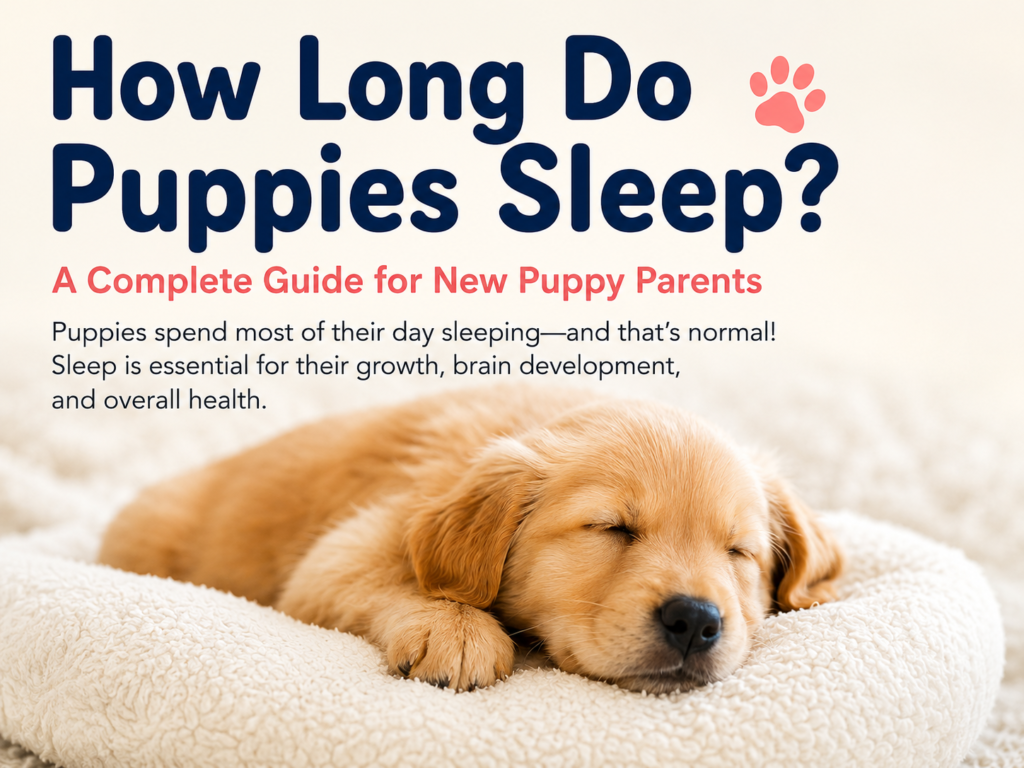
The Fast Answer
How Long Can Puppies Sleep? Yes, puppies really do sleep that much.
Most healthy puppies sleep between 18 and 20 hours a day during those early weeks. As they get older, that number slowly drops, but even a six-month-old puppy still usually needs about 14 to 16 hours of sleep every day.
That sounds like a lot.
And honestly? It is.
But according to the American Kennel Club (AKC) and VCA Animal Hospitals, long puppy naps are completely normal. While your puppy is curled up in a blanket looking useless and adorable, their body is doing serious work. Sleep helps support brain development, bone growth, muscle repair, memory, and immune function.
Your puppy isn’t being lazy.
They’re growing at full speed behind the scenes.
But there is a difference between healthy sleep and lethargy caused by illness. A puppy who wakes up bright-eyed, hungry, playful, and ready to investigate the nearest shoelace is very different from a puppy who is hard to wake, refuses food, or seems weak.
That’s the part worth watching.
This guide walks through how much sleep puppies need by age, what normal puppy sleep looks like, and when “sleeping a lot” might be a reason to call your veterinarian.
How Long Can Puppies Sleep? Puppy Sleep Hours by Age
Most first-time puppy owners are surprised by how dramatic the puppy sleep cycle can be.
One minute, your puppy is galloping across the room with a squeaky toy.
Ten seconds later, they’re asleep on the floor like someone unplugged them.
That’s normal puppy behavior.
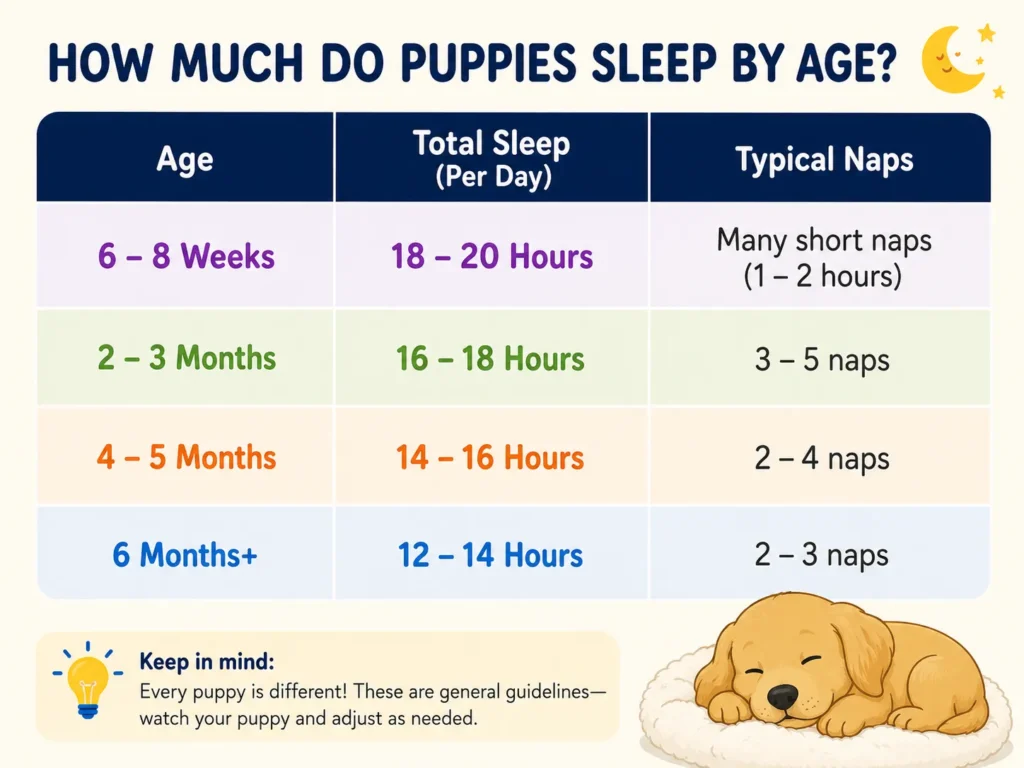
Puppies don’t have the same stamina or self-regulation as adult dogs. Their nervous systems are still developing, and their little bodies burn through energy quickly. They simply can’t stay awake for very long before their brain and body demand a reset.
Based on guidance from the American Kennel Club and VCA Animal Hospitals, these are common sleep ranges for healthy puppies.
These numbers are helpful, but they’re not carved into stone.
Some puppies sleep a little more. Some can comfortably stay awake a bit longer. Breed, personality, exercise, stress, household noise, and health all play a role.
I always tell new owners to look at the whole puppy, not just the clock.
If your puppy is eating well, growing normally, waking up cheerful, and acting like a tiny tornado after a nap, extra sleep usually isn’t a problem.
6 to 8 Weeks Old: Tiny Bodies Doing Big Jobs
Those first days after bringing a puppy home can feel messy, sweet, exhausting, and slightly ridiculous.
At 6 to 8 weeks old, most puppies sleep 18 to 20 hours a day, but they don’t usually do it in one neat overnight stretch.
Their day often looks more like this:
- Wake up.
- Potty.
- Eat.
- Play for a few minutes.
- Crash again.
A puppy this young may only stay awake for 30 to 45 minutes before getting overtired. That surprises people. Most new owners assume more play will help a puppy sleep better later.
Usually, it backfires.
I’ve seen this countless times. A puppy gets kept awake too long, and instead of becoming calm and sleepy, they turn into a furry paper shredder with teeth. More biting. More barking. More grabbing at socks, sleeves, and fingers.
That’s not always “bad behavior.”
Sometimes it’s just exhaustion wearing a little shark costume.
Vet Insight
Sleep is not just empty time.
Research in veterinary medicine and developmental biology shows that growth hormone is released mainly during deep sleep. That’s one reason very young puppies spend so much of the day asleep while their bones, muscles, and organs are developing fast.
The First 48 Hours at Home
The first two days at home can look strange.
Some puppies barely sleep.
Some sleep almost constantly.
Both can be normal.
Think about what just happened from your puppy’s point of view. Their mother is gone. Their littermates are gone. The familiar smells are gone. The sounds are different. The floor feels different. Even the water bowl might be in a weird place.
That’s a lot for a baby animal.
Some puppies respond by crying at night because they feel unsure. Others go the opposite direction and sleep more than usual because the move has worn them out.
As long as your puppy is eating, drinking, peeing, pooping, and slowly becoming more comfortable, those first-few-days sleep changes usually settle down on their own.
10 to 12 Weeks Old: Finding a Routine
By 10 to 12 weeks, many puppies start to feel a little more predictable.
Not fully predictable.
Let’s not get carried away.
But you may begin to see a rhythm. Puppies this age still need 16 to 18 hours of sleep, but their awake windows are usually longer and more useful.
This is a great age for short, simple training sessions because your puppy can often stay awake for about an hour at a time.
That gives you room for:
- Potty breaks
- Five-minute training sessions
- Gentle play
- Short walks in safe areas, if their vaccination status allows
- Quiet chewing time
- Scheduled naps
Here’s the part many people miss: don’t wait until your puppy collapses wherever they happen to be.
Many trainers recommend guiding puppies into a crate, pen, or quiet nap space before they get overtired. Done consistently, this teaches them that settling is part of the day, not a punishment.
That habit pays off later.
A puppy who learns how to rest usually becomes a much easier adult dog to live with.
4 to 6 Months Old: More Energy, Still Lots of Sleep
A lot of owners expect naps to disappear once a puppy hits four months.
They usually don’t.
Puppies this age can stay awake longer, play harder, and seem more coordinated, but they still need 14 to 16 hours of total sleep each day.
This stage often overlaps with teething too.
According to veterinary behavior experts, teething can temporarily disturb sleep. Sore gums are annoying. Loose baby teeth feel weird. New adult teeth pushing through the gums can make some puppies restless.
You may notice your puppy:
- Waking more often
- Acting unsettled at night
- Needing extra daytime naps
- Chewing everything after waking
Most of this passes once the adult teeth come in.
But during the thick of it, I like to keep safe chew toys nearby and lower my expectations a little. A teething puppy is not always being difficult. Sometimes their mouth simply hurts.
Information Gain: Awake Windows Matter More Than Total Sleep
Most puppy sleep advice focuses on the big number:
“Puppies sleep 18 to 20 hours.”
That’s useful.
But it doesn’t answer the question owners ask me most often:
“How long should my puppy stay awake before the next nap?”
That question matters.
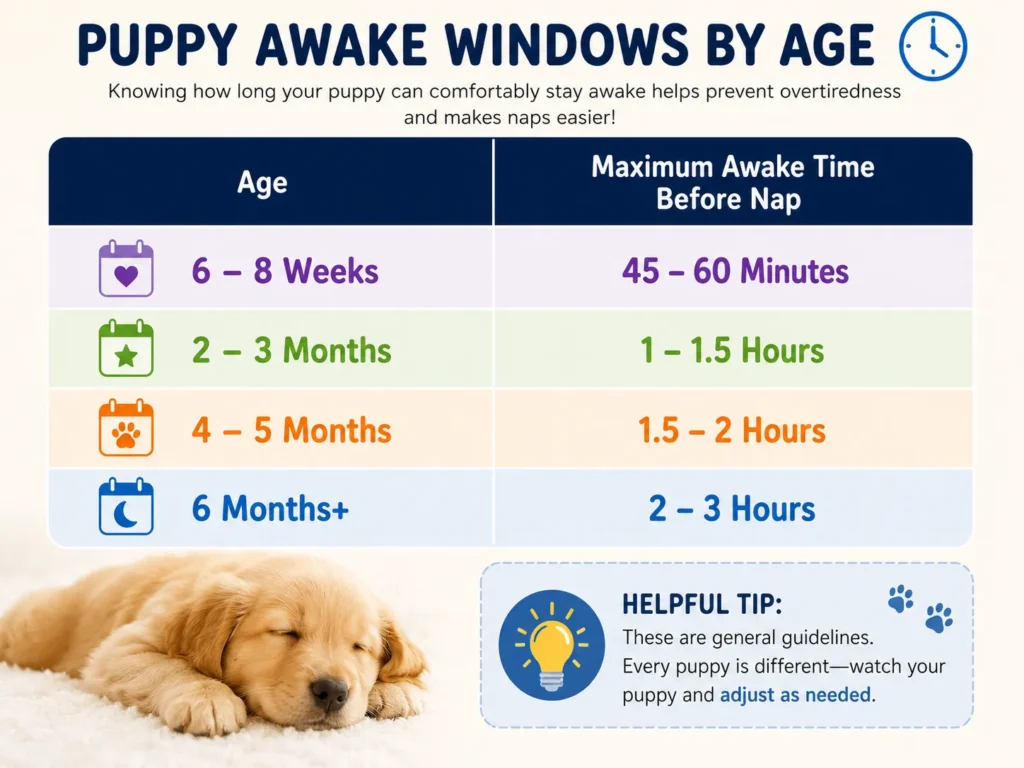
Professional trainers often pay close attention to awake windows, not just total sleep hours. Think of an awake window as your puppy’s battery life. When the battery gets too low, behavior starts to unravel.
A well-rested puppy can explore, play, learn, and respond to simple cues.
An overtired puppy?
Different creature.
They may start zooming around the house, biting harder, stealing clothes, ignoring things they knew five minutes ago, barking at nothing, and chewing like their tiny life depends on it.
Most first-time owners read that as “too much energy.”
I’ve noticed it’s often the opposite.
It’s the puppy version of a toddler melting down in the grocery store because nap time was missed.
Trainer Observation
Many certified trainers recommend putting puppies down for naps before they reach the wild-eyed, couch-circling stage.
Once they’re already racing through the room, you’ve probably missed the easiest sleep window.
A simple rhythm works well for many young puppies:
45 to 60 minutes awake -> potty break -> quiet crate time -> nap.
Keeping that cycle steady often creates a calmer puppy than trying to tire them out with more and more activity.
Charlie’s “Crazy Hour”
I hear versions of this story all the time.
Emma brought home Charlie, an eight-week-old Golden Retriever, and figured the evenings would be easy. After all, he’d been playing most of the day. Surely he’d be ready to settle down.
Instead, every evening around 7:30, Charlie transformed into what Emma laughingly called “a tiny dinosaur.”
He stole socks.
He chased shoelaces.
He barked at furniture that had done absolutely nothing to him.
And one favorite hoodie ended up with several tiny holes after an enthusiastic sleeve attack.
Emma assumed he still had energy to burn, so she played with him even longer.
Nothing improved.
During puppy class, the trainer asked a question that completely changed the situation.
“How long has Charlie been awake?”
Emma thought about it.
Almost two hours.
The trainer smiled and suggested skipping another game of tug.
Instead, Charlie went outside for a quick potty break, settled into his crate with a safe chew toy, and was encouraged to relax.
Five minutes later?
Fast asleep.
Over the next week, Emma started scheduling naps before Charlie hit that frantic stage. The evening biting didn’t disappear overnight, but it became much easier to manage.
Charlie hadn’t been asking for more exercise.
He’d been asking for more sleep.
Why Do Puppies Sleep So Much?
If this is your first puppy, all that sleeping can feel almost unbelievable.
How can something spend most of the day asleep… then wake up and race around the house like a rocket?
The answer is simple.
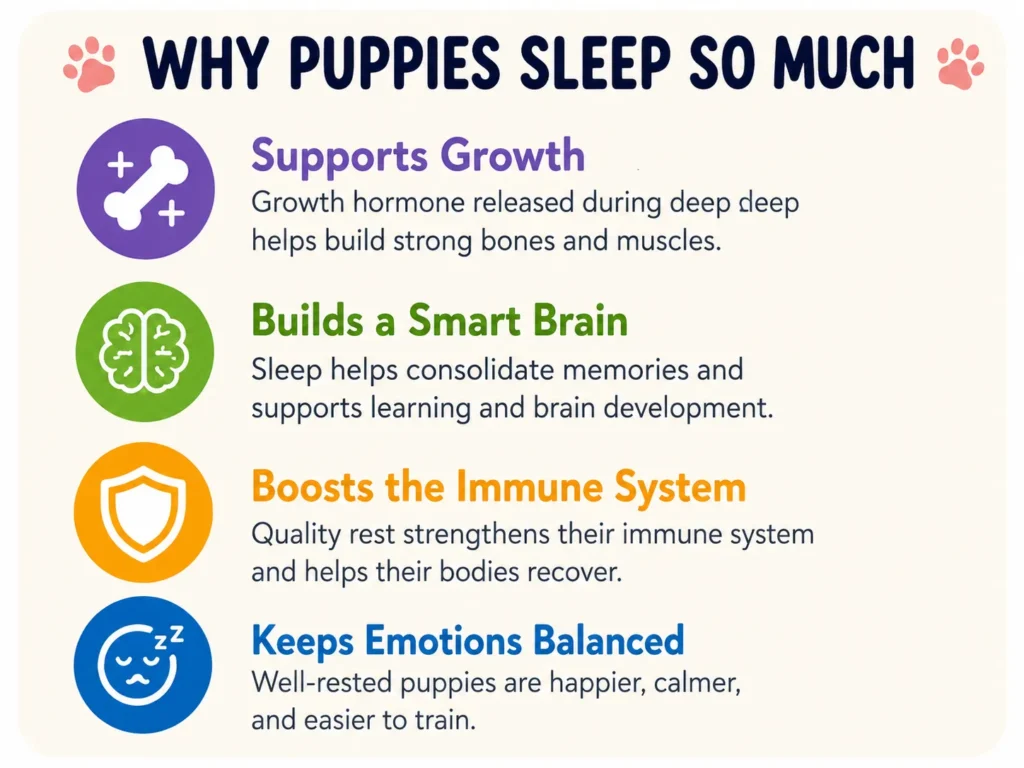
Sleep is when puppies do some of their biggest growing.
According to the American Kennel Club (AKC), VCA Animal Hospitals, and veterinary references including the Merck Veterinary Manual, young puppies rely on long, uninterrupted sleep to support healthy physical growth, brain development, learning, and immune function.
Adult dogs mainly use sleep to recover.
Puppies are using it to build themselves.
Every nap is part of that process.
Physical Growth Happens During Sleep
Puppies grow astonishingly fast.
Some large breeds, including Golden Retrievers, Labrador Retrievers, and German Shepherds, can gain several pounds in a single week during peak growth.
That kind of growth takes an incredible amount of energy.
During deep non-rapid eye movement (NREM) sleep, the body releases growth hormone, which plays a major role in:
- Bone development
- Muscle growth
- Tissue repair
- Organ development
- Healthy metabolism
One thing that surprises people is how much work a sleeping puppy is actually doing.
They may look like they’re simply curled up on the couch.
Meanwhile, their body is hard at work building stronger bones, developing muscles, repairing tissue, and preparing for another busy day.
That’s why veterinarians generally recommend letting healthy puppies finish their naps whenever possible.
Vet Insight
Many owners worry that every minute spent sleeping is a missed training opportunity.
I’ve found the opposite is usually true.
A puppy that’s had a good nap pays attention better, learns faster, and gets frustrated far less easily than one who’s been awake for hours.
Sometimes the smartest training decision is waiting until after a nap.
Sleep Builds a Smarter Puppy
Sleep isn’t only helping muscles grow.
The brain is just as busy.
Every single day, your puppy experiences hundreds of new things.
- Learning their name.
- Meeting visitors.
- Feeling grass under their paws.
- Hearing traffic.
- Playing with another dog.
- Exploring unfamiliar smells.
All of those experiences create new neural connections.
Without enough sleep, the brain has a harder time organizing and strengthening those memories.
Research from both animal and human neuroscience shows that sleep plays a critical role in memory consolidation, the process that turns new experiences into lasting learning.
That’s one reason many trainers like ending a short training session with a nap.
Your puppy isn’t forgetting what they learned.
Their brain is filing it away.
Research Highlight
Research consistently shows that sleep improves memory after new learning experiences. While much of the foundational work comes from broader neuroscience, veterinary behavior specialists widely recognize that adequate sleep supports healthy learning and cognitive development in growing puppies.
Sleep Supports the Immune System
A young puppy’s immune system is still under construction.
Every week they’re adapting to new environments, responding to vaccinations, encountering new bacteria, and continuing to develop.
Sleep gives the body valuable time to recover and recharge.
Nutrition, vaccinations, and genetics all contribute to immune health, but poor or disrupted sleep can place additional stress on a growing puppy.
That’s why veterinarians often recommend providing:
- A predictable daily routine
- A quiet place to nap
- Limited overstimulation
- Exercise that’s appropriate for the puppy’s age
Healthy sleep isn’t just about feeling rested.
It’s part of keeping your puppy healthy in the first place.
What Does Normal Puppy Sleep Look Like?
One of my favorite things about puppies is how dramatically they fall asleep.
There isn’t much warning.
One second they’re proudly carrying a toy across the living room.
The next…
They’re asleep with the toy still in their mouth.
Owners sometimes joke that puppies have an “off switch.”
Behaviorists sometimes call it the Popcorn Effect, because puppies seem to pop full of energy, bounce around for a while, then suddenly collapse into a deep nap.
That’s completely normal.
Young puppies simply haven’t developed the ability to pace themselves the way adult dogs do.
Their day usually follows a repeating cycle:
- Play.
- Explore.
- Learn.
- Crash.
- Then do it all over again.
The Popcorn Effect
I’ve noticed many first-time owners accidentally interrupt this natural rhythm.
Their puppy starts slowing down.
They yawn.
They wander off.
Instead of recognizing those as sleepy signals, it’s tempting to think:
“One more game won’t hurt.”
Unfortunately, that’s often the moment everything falls apart.
Those extra ten minutes can push a puppy from pleasantly tired into completely overtired.
Instead of getting sleepy, they become:
- Wild
- Extra bitey
- Loud
- Unable to settle
That’s why experienced trainers usually encourage naps before the zoomies begin.
It’s much easier to help a calm puppy fall asleep than an overtired one.
Trainer Observation
One trainer told me something years ago that’s stuck ever since:
“A crazy puppy is usually a tired puppy.”
The more puppies I’ve worked with, the more accurate that advice has proven.
A surprising number of behavior problems improve simply because the puppy starts getting enough scheduled rest.
Do Puppies Dream?
Yes.
Just like adult dogs, puppies experience Rapid Eye Movement (REM) sleep, the stage of sleep most closely associated with dreaming.
During REM sleep, it’s completely normal to notice:
- Paw twitching
- Small leg movements
- Whisker twitching
- Ear flicking
- Quiet barks
- Gentle whining
- Faster breathing
- Eyes moving beneath closed eyelids
The first time you see this, it can be startling.
I’ve had owners send me videos because they thought their puppy was having a seizure.
Fortunately, REM sleep usually looks quite different.
A dreaming puppy stays relaxed and can often be gently awakened if necessary.
A seizure typically involves rigid muscles, loss of awareness, uncontrolled movements, or difficulty recovering afterward.
If you’re ever unsure what you’re seeing, record a short video and show it to your veterinarian.
That’s often the quickest way to get a reliable answer.
Research Highlight
Veterinary neurologists believe puppies spend proportionally more time in REM sleep than adult dogs because their rapidly developing brains are processing an enormous amount of new information every single day.
Common Puppy Sleeping Positions
Your puppy’s favorite sleeping position can tell you a little about how comfortable they feel.
Not always.
Some puppies seem to invent a brand-new sleeping position every afternoon.
Still, there are a few patterns owners see again and again.
| Sleeping Position | What It Often Means |
| Curled into a ball | Conserving warmth and feeling secure |
| Lying on the side | Relaxed enough to enjoy deep sleep |
| Belly-up with paws in the air | Feeling safe and cooling off |
| Stretched out | Comfortable, relaxed, and regulating body temperature |
Don’t be surprised if your puppy changes positions several times during one nap.
Mine certainly did.
It’s completely normal for puppies to roll over, stretch, twitch, and settle back into a different position before waking up.
Sleep Regressions: Why Sleep Suddenly Gets Worse
Just when you think you’ve finally figured out your puppy’s routine…
Everything changes.
One week they’re sleeping beautifully.
The next they’re waking more often, skipping naps, or acting restless for no obvious reason.
Most owners assume they’ve done something wrong.
Usually, they haven’t.
These temporary changes are often called sleep regressions.
Unlike human babies, puppies don’t follow one predictable schedule for sleep regressions. There’s usually something causing the change.
Finding that reason makes life much easier.
Teething (Around 3–6 Months)
For many puppies, the biggest sleep disruptor is teething.
As baby teeth loosen and adult teeth begin pushing through the gums, the discomfort can make it harder to settle and stay asleep. Veterinary behavior specialists see this regularly.
You might notice your puppy:
- Waking more during the night
- Chewing everything in sight
- Having trouble settling before naps
- Whining while trying to fall asleep
- Looking for something to chew as soon as they wake up
I’ve noticed many owners mistake this for stubbornness.
Most of the time, it’s simply a sore mouth.
Giving your puppy safe chew toys before bedtime often helps take the edge off the discomfort and makes it easier for them to relax.
Growth Spurts
Sometimes owners message me because their puppy suddenly seems to sleep all day.
Then, just as suddenly, everything goes back to normal a week later.
Growth spurts often explain that pattern.
During these periods, it’s common for puppies to:
- Eat more than usual
- Sleep longer than usual
- Wake up noticeably hungrier
- Put on visible size over a matter of weeks
Here’s the reassuring part.
If your puppy is otherwise healthy, temporary increases in sleep are usually nothing to worry about.
Growing takes energy.
Sometimes the body simply asks for more rest.
Signs Your Puppy Is Overtired
Here’s something that catches a lot of first-time owners off guard.
Many puppy behavior problems don’t come from having too much energy.
They come from running on empty.
An overtired puppy may:
- Tear around the house with the zoomies
- Bite much harder during play
- Bark for no obvious reason
- Ignore cues they already know
- Tug at clothing
- Struggle to settle down
- Chew constantly
It doesn’t always look like exhaustion.
In fact, it often looks like the exact opposite.
| Well-Rested Puppy | Overtired Puppy |
| Learns quickly | Ignores cues |
| Plays gently | Bites harder |
| Calmly explores | Hyperactive |
| Settles after activity | Can’t relax |
| Normal chewing | Constant chewing |
Learning to spot the difference can make everyday life with a young puppy dramatically easier.
One thing I’ve learned over the years?
Sometimes the best training session is no training session at all.
Sometimes it’s simply time for a nap.
How to Create the Perfect Puppy Sleep Schedule
The goal isn’t making your puppy sleep more.
It’s helping them sleep before they become overtired.
That’s an important difference.
Many owners wait until the zoomies have already started.
By then, the puppy has often become overstimulated, stress hormones are circulating, and settling down is much harder than it needed to be.
A predictable daily rhythm usually works far better.
For many young puppies, it looks something like this:
- Wake up
- Go outside for a potty break
- Eat breakfast
- Spend 10 to 15 minutes playing or training
- Enjoy some quiet chewing time
- Take a nap
Then repeat that cycle throughout the day.
Puppies love consistency, even if they don’t always act like it.
According to behavior specialists from the American Veterinary Society of Animal Behavior (AVSAB), predictable routines help lower stress and make learning easier for growing puppies.
Create the Right Sleep Environment
Even the sleepiest puppy can struggle to settle in a busy environment.
A quiet nap space makes a bigger difference than many people realize.
Aim to keep your puppy’s sleeping area:
- Quiet
- Cool (around 65–72°F / 18–22°C)
- Dimly lit
- Comfortable
- Away from TVs, speakers, and constant foot traffic
Many puppies also sleep better in a properly introduced crate or playpen because it becomes a place where they feel safe.
One small change I’ve recommended countless times is moving the crate away from a busy hallway.
It sounds almost too simple.
But it often works surprisingly well.
Trainer Observation
If your puppy keeps waking every few minutes, don’t assume the puppy is the problem.
Take a look at the environment.
Household traffic, loud televisions, excited children, or people constantly walking past the crate can interrupt sleep over and over again.
Sometimes changing the location solves the issue faster than changing the puppy.
Should You Wake a Sleeping Puppy?
Most of the time?
No.
Healthy puppies should usually be allowed to finish their naps naturally.
There are a few exceptions, though.
You may need to wake your puppy if:
- Your veterinarian has scheduled medication at a specific time
- They have an upcoming medical appointment
- They’re following a very young potty-training schedule
- They’re unusually difficult to wake and you need to check their condition
Outside of situations like these, let sleeping puppies sleep.
Repeatedly interrupting deep sleep can leave them cranky, overstimulated, and less able to focus during training.
Think of sleep as part of your puppy’s daily routine, not time that’s being wasted.
Normal Sleep vs. Lethargy
This is probably the question I get asked more than any other.
“Is my puppy just sleeping… or are they sick?”
The answer usually becomes obvious after they wake up.
A healthy puppy might sleep for two hours, stretch, shake off the nap, and immediately start searching for breakfast, a toy, or someone to play with.
A lethargic puppy acts very differently.
They may wake briefly…
Then lie right back down.
They ignore food.
| Healthy Sleep | Possible Lethargy |
| Wakes easily | Difficult to wake |
| Eats normally | Refuses food |
| Wants to play | Little or no interest in play |
| Bright, alert eyes | Dull expression |
| Returns to normal energy | Remains weak |
They aren’t interested in people.
Even their favorite toy doesn’t seem exciting.
When owners tell me, “My puppy sleeps all day,” my first question is almost never how long they’re sleeping.
It’s always:
“What are they like when they wake up?”
That answer usually tells you far more than the number of hours they spent asleep.
Emergency Warning
Sleeping by itself is rarely an emergency.
Sleeping along with other symptoms can be.
Contact your veterinarian immediately if excessive sleeping is accompanied by:
- Vomiting
- Diarrhea
- Bloody stool
- Pale gums
- Difficulty standing
- Collapse
- Trouble breathing
- Refusing both food and water
If your puppy is also vomiting or has bloody diarrhea, serious illnesses such as canine parvovirus need to be ruled out as quickly as possible.
Internal Link Suggestion: Can Parvo Be Treated in Puppies? Recovery, Costs & Early Signs
Luna Slept All Day… and Was Perfectly Healthy
Sophie had only owned Luna, her nine-week-old Labrador Retriever, for a few days before she became convinced something was wrong.
Luna seemed to nap after almost every play session.
She’d wake up, bounce around for a little while, then fall asleep again.
At the veterinary visit, Sophie explained her concern.
The veterinarian asked one simple question.
“What does she do after she wakes up?”
Sophie laughed.
“She runs straight to her food bowl, then steals a toy.”
The veterinarian smiled.
“That’s exactly what I hoped you’d say.”
Over the following months, Luna gradually stayed awake longer between naps while remaining playful, curious, and full of energy whenever she was awake.
She wasn’t sleeping too much.
She was simply doing what healthy puppies are designed to do.
Frequently Asked Questions
Can a Puppy Sleep Too Much?
Usually, no.
Most healthy young puppies naturally sleep somewhere between 16 and 20 hours a day. If your puppy wakes up excited to eat, happily plays, gains weight, and continues developing normally, those long naps are generally nothing to worry about.
One thing that surprises many new owners is how quickly puppies can go from sound asleep to full-speed zoomies. That’s completely normal.
Why Does My Puppy Breathe So Fast While Sleeping?
Fast breathing during sleep is often linked to REM sleep, especially when puppies are dreaming. You may also notice twitching paws, tiny barks, soft whimpers, or their eyes moving beneath closed eyelids. Those are all common dream-related behaviors.
What isn’t normal is labored breathing, blue or gray gums, or breathing that looks difficult even after your puppy wakes up. If you notice those signs, contact your veterinarian right away.
Should I Wake My Puppy to Pee at Night?
Sometimes, but it depends on age. Very young puppies can’t hold their bladder for very long, so scheduled nighttime potty breaks may still be necessary.
As they grow and develop better bladder control, most puppies naturally begin sleeping through the night without needing to be woken. If you’re unsure what’s appropriate for your puppy, your veterinarian or breeder can help you adjust the schedule based on their age and development.
How Long Should a Puppy Stay Awake?
Age makes a big difference. An eight-week-old puppy usually manages only 45 to 60 minutes before needing another nap. By six months of age, many puppies can comfortably stay awake for 2 to 3 hours before they’re ready to rest again.
I’ve found it’s often better to watch the puppy instead of the clock. If they suddenly become mouthier, start ignoring cues, race around the house, or seem unable to settle, they’re often telling you they’re overdue for a nap.
Why Does My Puppy Get Zoomies Before Bed?
Evening zoomies aren’t usually a sign that your puppy needs another hour of exercise. They’re often a sign they’ve stayed awake for too long. An overtired puppy can look unbelievably energetic.
A short potty trip followed by a calm bedtime routine usually works much better than another game of fetch or tug. It feels backwards at first, but it works surprisingly often.
Why Does My Puppy Sleep on Their Back?
Most puppies only expose their belly when they feel relaxed and secure. Sleeping on their back with all four paws in the air usually means they feel safe in their surroundings.
It’s also a great way for them to cool off because there’s less fur covering their belly. If your puppy loves this position, it’s generally a good sign that they’re comfortable where they’re sleeping.
Can Puppies Dream?
Absolutely. Like adult dogs, puppies experience REM sleep, the stage most closely associated with dreaming. During this phase, it’s perfectly normal to see:
- Paw twitching
- Running motions
- Eye movement beneath closed eyelids
- Small barks or whimpers
- Gentle body twitches
The first time you see it can be a little alarming. I’ve had plenty of owners tell me they almost woke their puppy because they thought something was wrong. Thankfully, dreaming is a perfectly healthy part of normal puppy sleep.
Does Teething Affect Sleep?
Yes. Many puppies sleep a little differently between three and six months of age while they’re teething. Sore gums can make it harder to settle down, and some puppies wake more often because they’re uncomfortable.
Offering safe chew toys before bedtime often helps soothe sore gums and makes it easier for them to relax. Fortunately, this phase doesn’t last forever. Once the adult teeth finish coming in, sleep usually becomes much more predictable again.
Final Thoughts
Watching a puppy sleep for hours can feel strange the first time you experience it. I remember checking on mine more times than I’d like to admit, convinced there was no way a healthy puppy could sleep that much.
Turns out…
That’s exactly what healthy puppies do.
Those long naps aren’t wasted time. They’re helping build stronger bones, healthier muscles, a developing immune system, and a brain that’s busy making sense of an entirely new world.
If there’s one takeaway I’d leave you with, it’s this:
Don’t focus only on the number of hours your puppy sleeps. Pay even closer attention to what happens after they wake up.
A puppy who stretches, trots over for breakfast, grabs a toy, and starts looking for adventure is giving you some pretty reassuring information. They’re healthy. They’re growing. And they probably just needed another good nap.
Medical Reviewer
Reviewed Against Current Veterinary Guidance
This article has been prepared using guidance from recognized veterinary organizations and educational resources. It is intended for educational purposes only and should not replace professional veterinary advice, diagnosis, or treatment.
Last Reviewed: June 2026
Editorial Standard: Medical information is reviewed against current veterinary recommendations before publication. Sleep requirements vary between breeds, ages, individual development, and overall health.
References
- American Kennel Club (AKC). How Much Do Puppies Sleep?
- American Veterinary Society of Animal Behavior (AVSAB). Position Statements on Puppy Development.
- VCA Animal Hospitals. Sleep and Behavior in Puppies.
- Merck Veterinary Manual. Normal Growth and Development of Dogs.
- Cornell University Richard P. Riney Canine Health Center. Puppy Health and Development.
- American Animal Hospital Association (AAHA). Canine Preventive Care Guidelines.
- World Small Animal Veterinary Association (WSAVA). Guidelines for Puppy Care.
Internal Linking Opportunities
- Can Parvo Be Treated in Puppies?
- How to Get a Puppy to Stop Biting
- When Can Puppies Go Outside?
- Puppy Vaccination Schedule
- Can Puppies Eat Corn?