Dog Breeds Guide
When Is a Dog Considered a Senior? Age, Signs, and Care by Size
There is no single birthday …
DOGSORIA DOG CARE GUIDE
There is no single birthday when every dog becomes a senior.
QUICK ANSWER
The short answer
A Great Dane may enter the senior stage while a Chihuahua of the same age is still in adulthood. Size, breed, expected lifespan, health, and day-to-day function all matter.
QUICK FACTS
5–7 years
As a pr…
25%
AAHA’s senior-stage definition.
9–12 years
Small dogs may become seniors.
There is no single birthday when every dog becomes a senior.
Overview
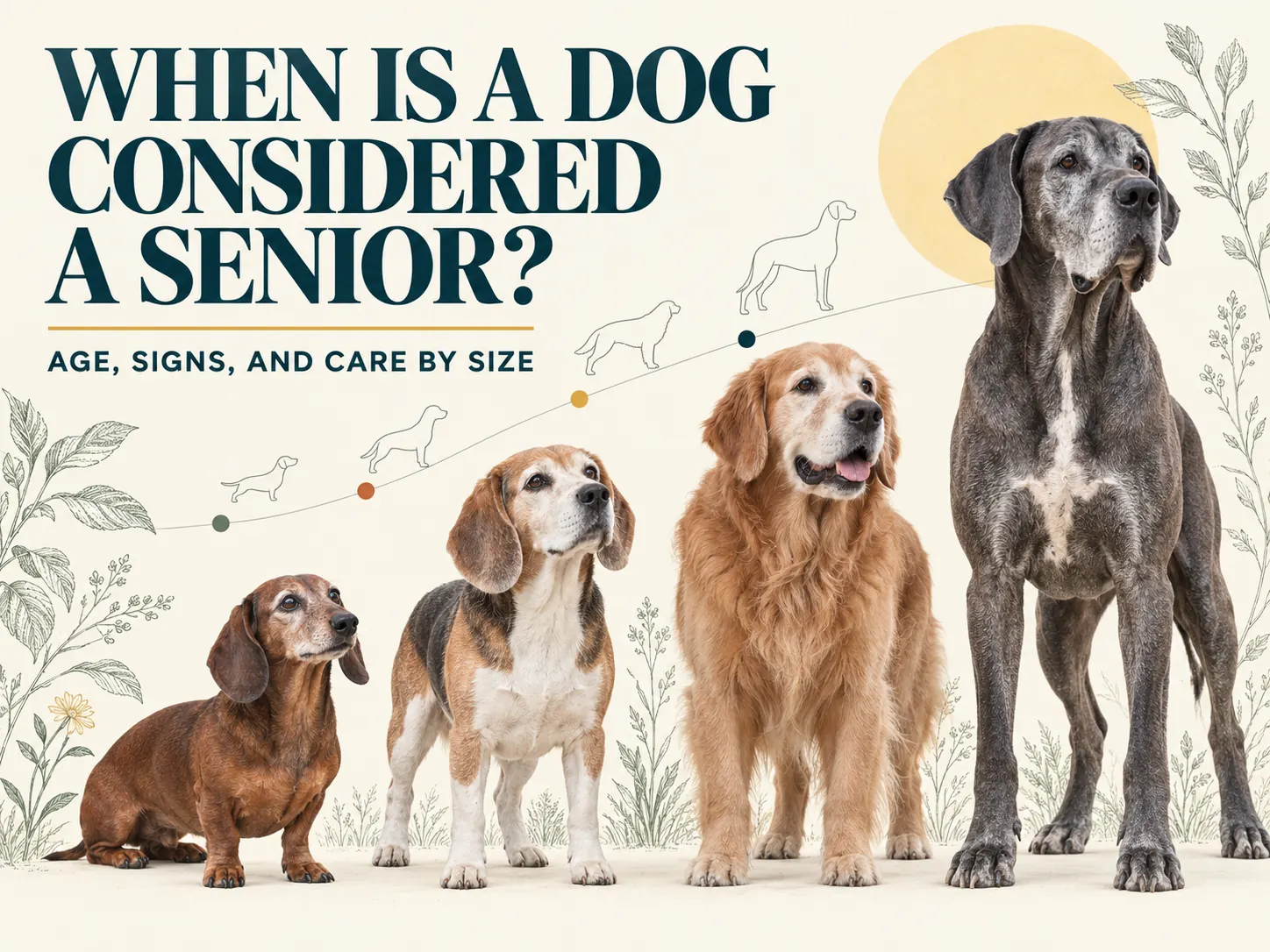
As a practical guide, giant dogs may become seniors around 5–7 years old, large dogs around 7–9, medium dogs around 8–10, and small dogs around 9–12. These are useful ranges—not expiration dates or diagnoses.
The more useful question is:
Is my dog entering the final stage of life where their health, comfort, and daily abilities need closer attention?
That is what the senior life stage helps you understand.
Quick Facts
- Dogs do not all become seniors at age 7.
- Large and giant dogs usually reach the senior stage earlier than small dogs.
- Veterinary guidelines describe the senior stage as roughly the final 25% of a dog’s expected lifespan.
- New changes in movement, appetite, sleep, weight, or behavior should not automatically be dismissed as “just old age.”
When Is a Dog Considered a Senior?
The American Animal Hospital Association (AAHA) defines the senior stage as the final 25% of a dog’s estimated lifespan through the end of life.
That definition is more useful than choosing one fixed age because dogs have very different lifespans. A breed expected to live around eight years enters the final quarter of life much sooner than a breed that commonly lives for fourteen or fifteen years.
It also explains why reputable sources publish different ranges. They may use different weight categories, breed examples, lifespan estimates, or clinical purposes.
Neither number should be treated like a switch that flips on a birthday.
Think of senior status as a transition zone—not a diagnosis.
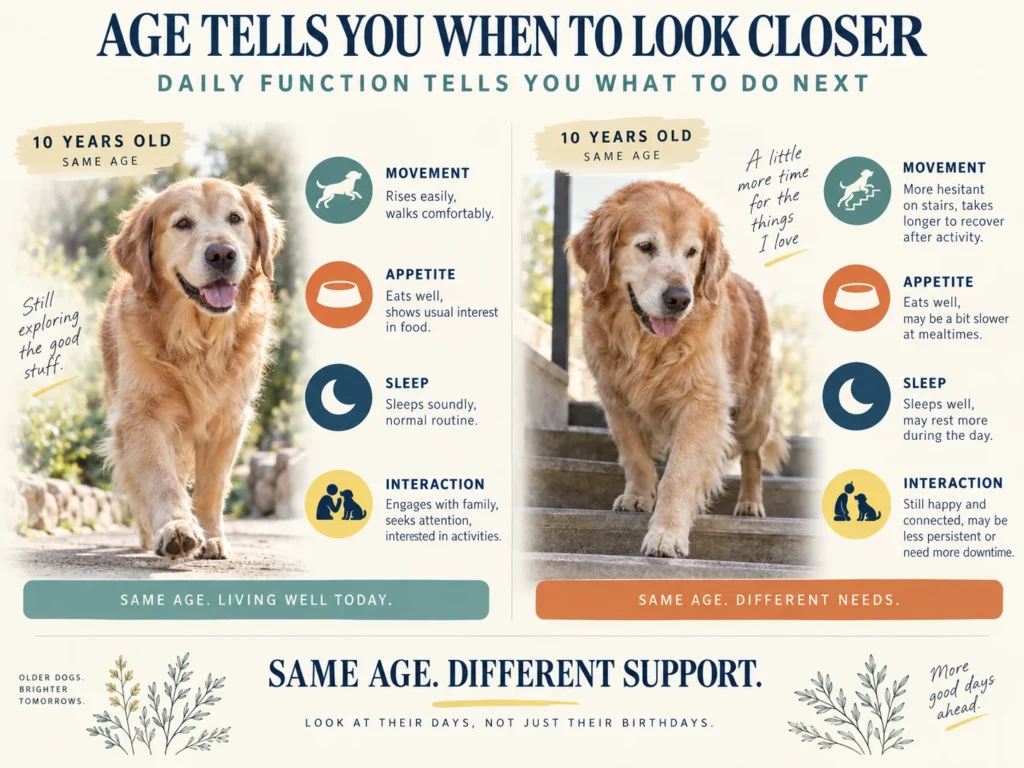
Age tells you when to look closer. Your dog’s daily function tells you what to do next.
Two dogs can be the same age and need very different support. One may still rise easily, enjoy a familiar walk, eat normally, sleep well, and recover comfortably. The other may hesitate before standing, avoid stairs, lose muscle, wake at night, or withdraw from activities they once enjoyed. Both may be senior by age, but their daily function tells you whether care needs to change now.
If you are unsure where your dog is in that transition, start with the [Dogsoria Dog Age Calculator] and then discuss the result with your veterinarian.
Senior Dog Age by Size
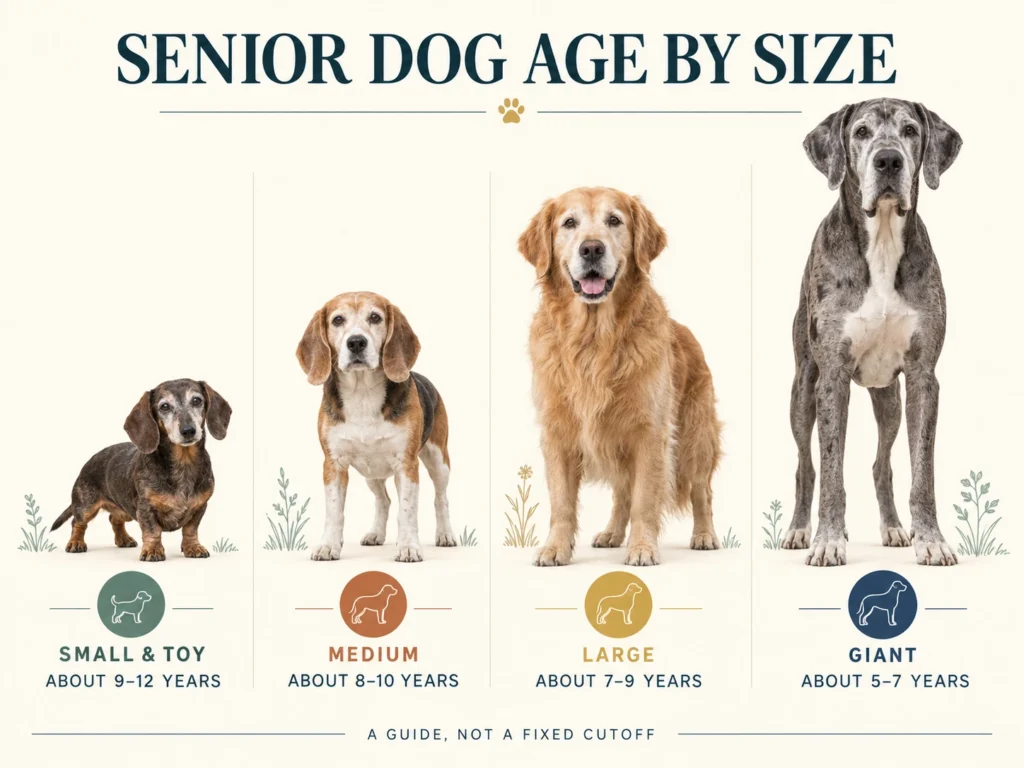
The ranges below are a practical starting point, not universally agreed veterinary cutoffs. AAHA uses expected lifespan rather than assigning one age to each size group. The ranges reflect the size pattern also shown in Banfield’s veterinarian-reviewed guide, while leaving room for differences between breeds and individual dogs.
| Adult size | Typical senior-age range | What to remember |
|---|---|---|
| Toy and small dogs | About 9–12 years | Longer average lifespans usually place the transition later. |
| Medium dogs | About 8–10 years | Individual lifespan can vary significantly, especially in mixed-breed dogs. |
| Large dogs | About 7–9 years | Shorter average lifespans usually bring the transition forward. |
| Giant dogs | About 5–7 years | Shorter-lived breeds may enter the final quarter of life surprisingly early. |
Use these ranges to ask better questions—not to declare a healthy dog suddenly frail or every change normal because of age.
The pattern matters more than memorizing four separate birthdays: larger dogs generally reach the senior stage earlier, while smaller dogs generally reach it later. Breed, adult weight, medical history, body condition, and individual lifespan can move the transition in either direction. For a mixed-breed dog, size is a useful starting point, but your veterinarian may interpret it alongside likely breed ancestry and long-term health trends.
Senior also does not mean “at the end.” A playful giant dog may be senior at six, while an active small dog may remain a mature adult at eight. The label simply tells you when closer observation becomes more useful.
Is a 7-Year-Old Dog Always a Senior?
No. Age 7 is a useful reminder, not a universal dividing line.
For some large dogs, seven may fall within the senior transition. For a giant breed, senior care may already be appropriate. For many small dogs, seven is still mature adulthood.
The traditional “one dog year equals seven human years” rule does not reflect how dogs actually develop and age. Dogs mature rapidly when young, and their later aging rate differs by size and breed.
So if your dog has just turned seven, do not assume they are suddenly old. Instead, use the birthday as a prompt to review:
- Has their weight, muscle condition, or exercise recovery changed?
- Are they hesitant on stairs, slippery floors, or furniture?
- Have their sleep, appetite, thirst, or bathroom habits changed?
- Does their current veterinary plan still fit this life stage?
This turns an arbitrary number into a useful health conversation—and keeps the life-stage label connected to the dog in front of you.
Signs Your Dog May Be Entering the Senior Stage
Dogs do not always look old when their needs change. Early signs may be small: taking longer to stand, choosing a shorter route, or becoming less comfortable with disruption.
What matters is knowing what to observe and what to do next.
Changes That Can Be Part of Normal Aging
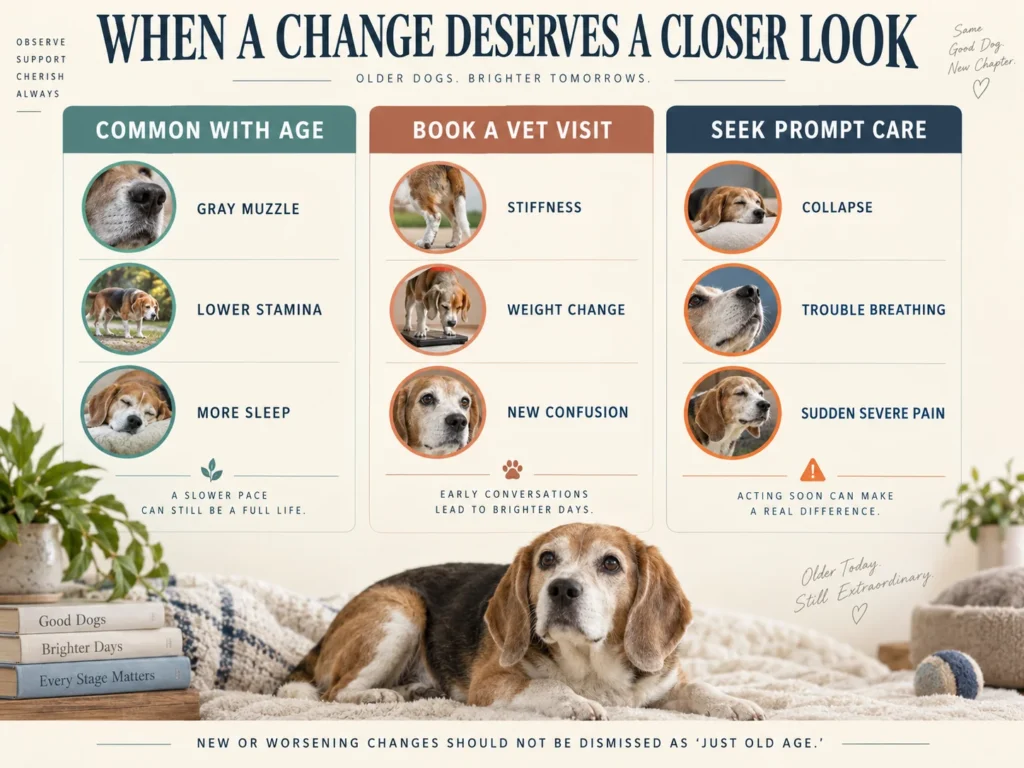
Some gradual changes are commonly seen as dogs grow older:
- Gray or thinning fur, especially around the muzzle
- Slightly lower stamina
- More time spent sleeping
- Gradual changes in hearing or vision
- Needing longer recovery after activity
- Preferring familiar routines
These changes still belong in your dog’s health record. “Common with age” does not mean “never worth mentioning.” Tracking when a change began helps your veterinarian understand whether it is stable or progressing.
Changes That Deserve a Veterinary Appointment
Book a checkup if you notice:
- Difficulty standing, climbing stairs, jumping, or settling comfortably
- Limping, stiffness, trembling, or reduced interest in walks
- Unexplained weight gain, weight loss, or muscle loss
- New bad breath, chewing difficulty, bleeding gums, or dropped food
- Increased thirst or urination
- Changes in appetite or digestion
- Nighttime restlessness, pacing, confusion, or house-soiling
- Reduced interaction, unusual anxiety, or new irritability
- New lumps or bumps
- Noticeable changes in hearing or vision
These signs are not automatically harmless consequences of aging. Pain, dental disease, sensory loss, organ disease, and cognitive dysfunction can produce similar changes.
Signs That Need Prompt Care
Contact a veterinarian promptly if your dog has difficulty breathing, collapses, has a seizure, develops a swollen abdomen, cannot stand, stops eating, repeatedly vomits, has prolonged diarrhea, or shows sudden severe pain or confusion.
The goal is not to make every change frightening. It is to stop treatable problems from hiding behind the phrase “they’re just getting old.”
What Actually Changes Once Your Dog Is Senior?
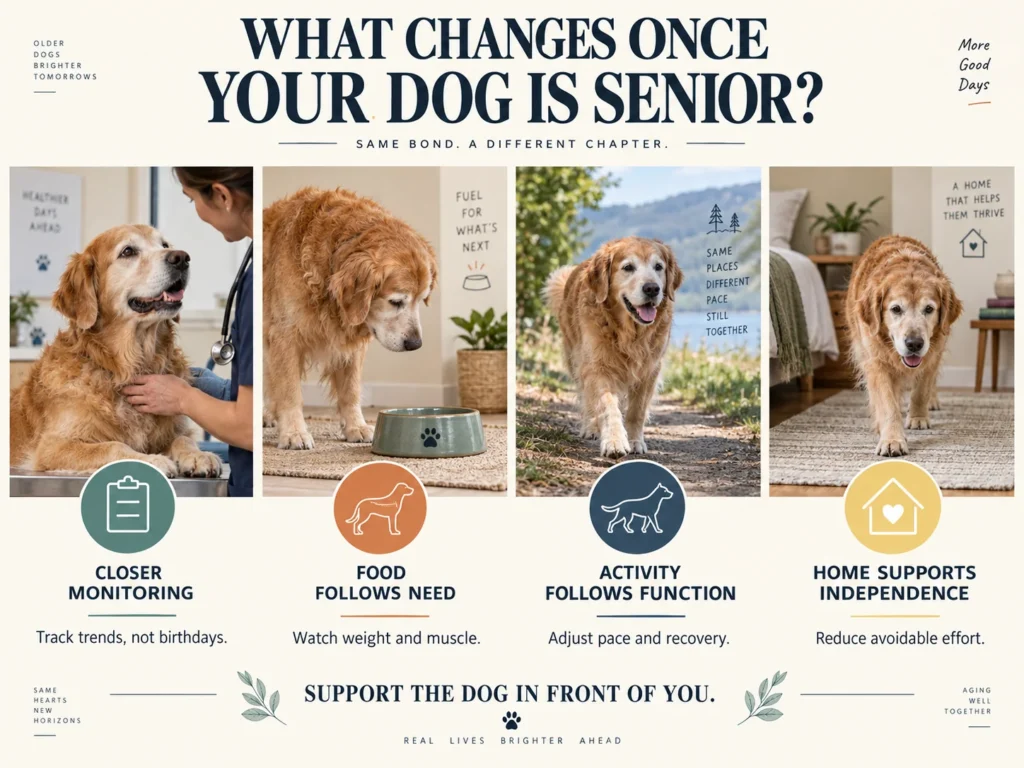
Becoming senior does not require rebuilding your dog’s whole life overnight. The practical shift is from preparing for later-life change to actively watching function and responding earlier.
You are looking for small losses in comfort or function before they become major ones.
Monitoring Becomes More Frequent and More Specific
Senior dogs often benefit from veterinary evaluation about every six months, although the right schedule depends on health status and existing conditions.
AAHA’s diagnostic guidance lists a complete blood count, blood chemistry, and urinalysis at 6–12-month intervals for senior dogs. It does not mean every test is mandatory for every dog: additional screening should reflect breed, symptoms, medication use, lifestyle, previous results, and examination findings.
The purpose is to establish trends. A result that is normal today may still matter if it has changed steadily from your dog’s previous baseline.
Food and Activity Follow Function, Not the Calendar
Senior does not automatically mean your dog needs a bag labeled “senior food.” AAHA’s nutrition guidance emphasizes an individualized assessment rather than one diet for every older dog.
Some older dogs need fewer calories; others lose weight or muscle and need a different approach. Medical conditions may require a veterinarian-directed diet.
Watch both weight and body shape. A stable number on the scale can hide muscle loss if fat is increasing at the same time.
Before changing food, ask what you are trying to solve: excess weight, muscle loss, dental difficulty, poor appetite, or a diagnosed condition. The answer should guide the diet—not the birthday printed on the calendar.
Senior dogs still need regular movement. What changes is the dose: a shorter route, steadier pace, lower-impact play, or more recovery time may preserve activity without asking the dog to push through discomfort. Judge an activity by how your dog moves during it and recovers afterward—not only by their excitement at the start.
The Environment Starts Supporting Independence
Home changes should answer a visible need. Nonslip rugs can help a dog who braces on smooth floors; a stable ramp can replace a painful jump; a low-entry bed, night-light, or easier bathroom access can reduce effort and uncertainty.
The same rule applies to cognitive and behavioral support. Keep familiar routines and gentle enrichment, but record new pacing, nighttime waking, house-soiling, anxiety, or disorientation. These changes can be associated with cognitive aging, but pain, sensory loss, and other medical problems should be considered first. Notes and short videos give your veterinarian a clearer view of daily function than the word “slower.”
Mature Adult vs. Senior: What Is the Difference?
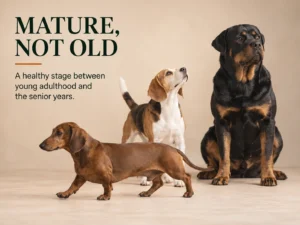
A mature adult dog may begin to show subtle age-related changes, but the main goal is still early prevention: maintaining a healthy weight, preserving fitness, building health baselines, and watching for trends.
A senior dog has entered the later portion of their expected lifespan. The goal shifts toward closer monitoring, earlier response, and protecting daily comfort and function.
| Mature Adult | Senior |
|---|---|
| Early prevention | More active monitoring |
| Establish health baselines | Compare current results with those baselines |
| Preserve strength and healthy weight | Manage changing mobility, muscle, and health risks |
| Notice subtle early changes | Respond to functional, sensory, or cognitive changes |
| Prepare for later-life needs | Adjust care and environment as needs appear |
The stages overlap because aging is gradual. A label does not change the dog overnight.
If your dog is showing only early changes and has not entered the final part of their expected lifespan, read our [Mature Adult Dog Guide].
A Function-First Senior Dog Check-In
Once your dog approaches the senior range, use this short check-in each month. You are looking for trends, not expecting every box to stay perfect.
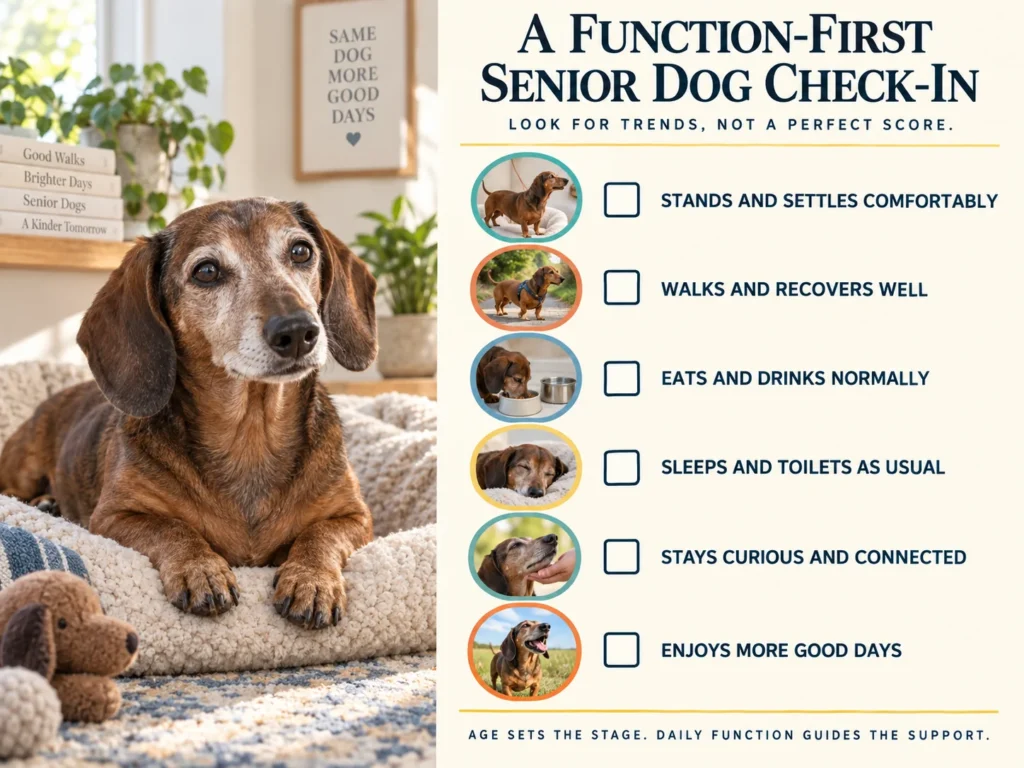
- Confirm their likely life stage using size, breed, and expected lifespan.
- Ask your veterinarian how often examinations and screening tests are appropriate.
- Watch how they stand, walk, climb, jump, settle, and recover after activity.
- Track weight, muscle shape, appetite, thirst, sleep, and bathroom habits.
- Notice whether hearing, vision, dental comfort, or behavior is changing participation in daily life.
- Adjust food, exercise, or the home only in response to an identified need.
- Write down what a good day looks like, so gradual changes are easier to recognize.
The point is not to score your dog. It is to notice whether they can still do the things that make up their normal day—and where one thoughtful change could help.
Senior Is a Care Stage, Not a Countdown
Calling a dog “senior” is not a prediction of how much time they have left. It is an invitation to look closer.
Age tells you when that closer look becomes worthwhile. Daily function tells you what support is actually needed: the step they now hesitate before taking, the weight that has slowly changed, the walk that takes longer to recover from, or the routine that helps them feel secure.
Your dog is still the same dog. The goal is not to make their world smaller because they are older. It is to make that world easier to move through, more comfortable to live in, and better matched to who they are now.
Start by checking your dog’s current life stage with the [Dogsoria Dog Age Calculator], then use what you learn to plan the next conversation with your veterinarian.
FAQ
Frequently asked questions
What age is a dog considered old?
There is no universal age. AAHA defines senior as the final 25% of expected lifespan. As a practical range, giant dogs may enter this stage around 5–7 years, while small dogs may not reach it until around 9–12 years.
Is a 7-year-old dog a senior?
It depends. Seven may be senior for a large or giant dog, but many small dogs are still mature adults at that age. Breed, expected lifespan, health, and function all matter.
How often should a senior dog see the veterinarian?
Many senior dogs benefit from checkups about every six months. Chronic conditions, medications, or new symptoms may require more frequent monitoring.
Should I switch to senior dog food at age 7?
Not automatically. Choose food based on body condition, muscle mass, activity, dental comfort, medical needs, and veterinary advice—not age alone.
Do senior dogs still need exercise?
Yes. Most senior dogs benefit from regular, appropriate movement. The duration, surface, intensity, and recovery time may need to change as mobility and stamina change.
Additional FAQ content to review
How do I know whether a change is normal aging?
Gradual gray fur or mildly reduced stamina may accompany normal aging. Changes involving pain, weight, appetite, thirst, bathroom habits, mobility, sleep, or behavior deserve veterinary attention, especially when they are new or worsening.
SOURCES
Sources & scientific references
- American Animal Hospital Association: Canine Life Stage Definitions ↗
- American Animal Hospital Association: Defining the Senior Patient ↗
- American Animal Hospital Association: Diagnostic Tests and Recommended Frequencies for Senior Dogs and Cats ↗
- American Animal Hospital Association: Nutrition ↗
- Banfield Pet Hospital: At What Age Is a Dog or Cat Considered a Senior? ↗
MORE FROM THIS CATEGORY