Dog Breeds Guide
Puppy Development Stages by Month: From Birth to Adulthood
Puppies change remarkably fa…
QUICK ANSWER
The short answer
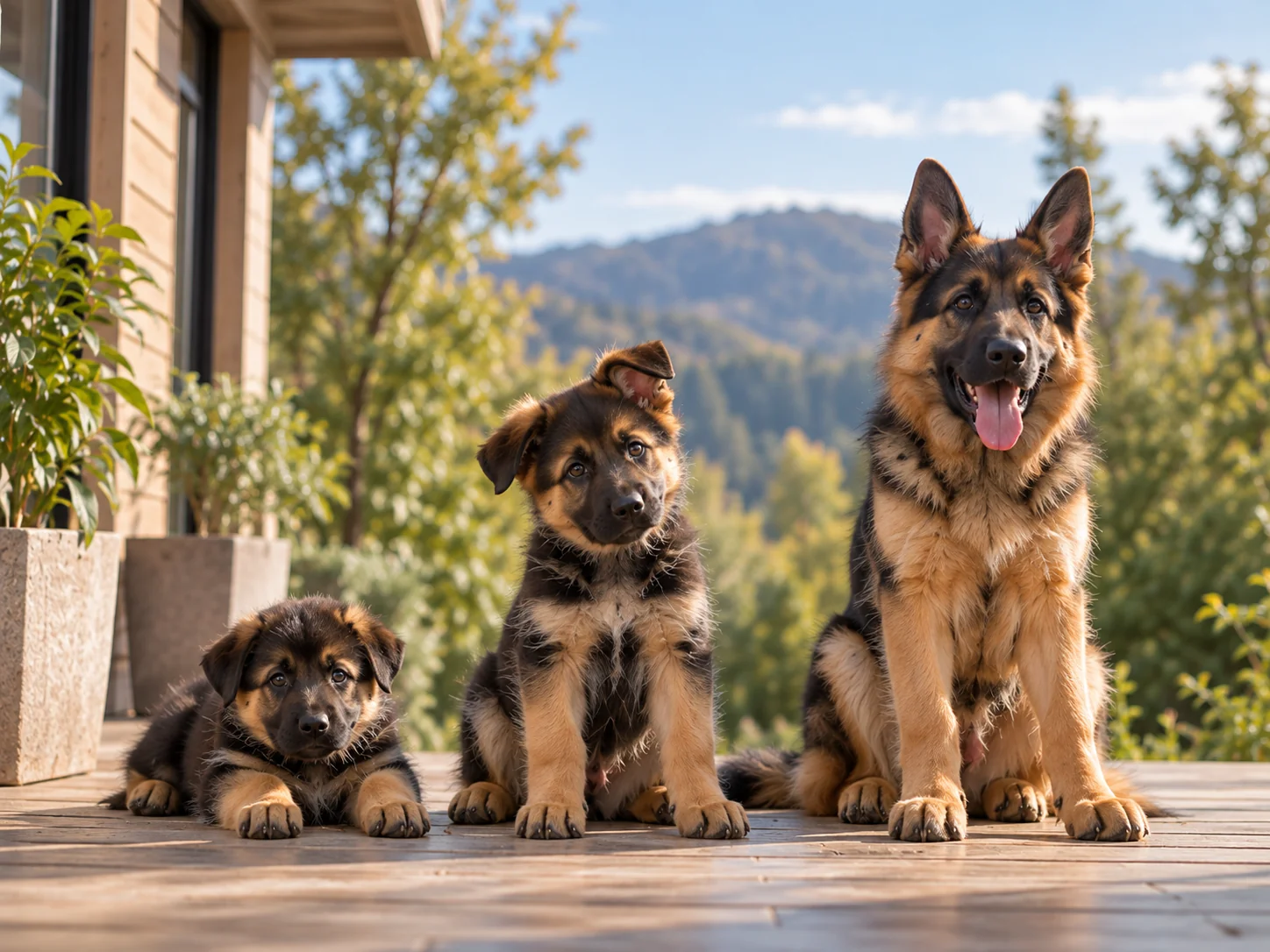
Puppy development is commonly described through several overlapping stages: the neonatal stage, transitional stage, socialization period, juvenile stage, and adolescence.
The fastest changes happen during the first few months. Puppies go from being completely dependent on their mother to walking, playing, learning social skills, eating solid food, teething, exploring their environment, and becoming increasingly independent.
QUICK FACTS
3–12/16 weeks
Key socialization window
3–6 months
Typical teething period
18–24months
Some large breeds may still be maturing
Puppies change remarkably fast during their first year. A newborn puppy that cannot see or hear will begin walking within weeks, enter an important socialization period soon after, start losing baby teeth at a few months old, and eventually move into adolescence.
Overview
But puppy development does not follow one exact calendar.
Different sources use slightly different names and age ranges for puppy development stages. Breed size matters too: small dogs generally reach physical maturity earlier, while large and giant breeds may continue growing and developing well into their second year.
This guide follows puppy development from birth toward adulthood, explaining the major physical and behavioral changes at each stage, what owners should focus on, and why being “an adult” can mean different things.
Important planning details
There is no single birthday when every puppy becomes an adult.
Physical growth, sexual maturity, skeletal maturity, behavioral maturity, and the transition between veterinary life stages can happen at different times. Small dogs generally mature earlier, while large and giant breeds may continue developing for 18–24 months or longer.
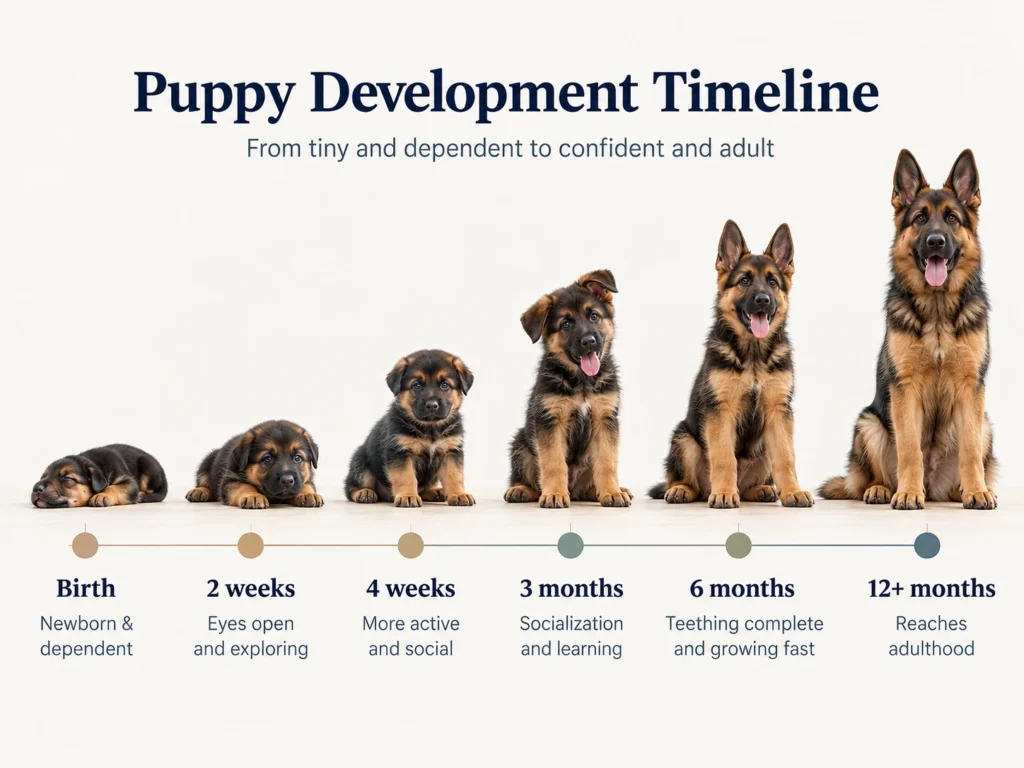
Puppy Development Stages at a Glance
| Puppy Age | Developmental Stage | Key Milestones | What Owners Should Focus On |
|---|---|---|---|
| Birth–2 weeks | Neonatal | Eyes and ears closed, nursing, rapid early growth | Warmth, nutrition, monitoring |
| 2–4 weeks | Transitional | Eyes and ears open, walking begins, early play | Safe exploration and gentle handling |
| 3–12/16 weeks | Socialization | Rapid learning, social bonding, environmental exploration | Positive socialization and early training |
| 3–6 months | Juvenile | Teething, rapid growth, increasing independence | Training, routines, appropriate exercise |
| 6–12 months | Adolescence | Increasing independence, sexual maturity, more distraction | Consistent training and boundaries |
| 12–24 months | Continued maturation | Larger breeds may still be growing; behavior continues maturing | Long-term habits, exercise, adult-care transition |
These age ranges are guidelines, not deadlines. Development happens gradually, several stages overlap, and individual puppies may progress at different rates.
Not sure which life stage your dog is in?
Use the Dog Age Calculator to estimate your dog’s life stage based on age and size.
Why Puppy Stage Timelines Don’t Always Match
Compare several puppy development charts and you may notice something confusing: their age ranges do not always agree.
One source might describe the socialization period as roughly 3–12 weeks, while another extends it to 14 or 16 weeks. One guide might refer to a 10-month-old dog as a puppy, while a veterinary life-stage framework may already place that dog in a broader Young Adult category.
View details for “Why Pupp…”
That does not necessarily mean one timeline is wrong.
The difference often comes down to what kind of development the timeline is describing.
Developmental Stages vs. Life Stages
A developmental stage describes changes happening in a puppy’s body, brain, senses, learning, or behavior.
Terms such as neonatal, transitional, and socialization period belong to this type of timeline.
A life stage is broader. Veterinary frameworks use life stages to organize age-related health and preventive care.
For example, the American Animal Hospital Association (AAHA) defines the Puppy life stage as beginning at birth and continuing until the end of rapid growth, typically around 6–9 months depending on the dog. The Young Adult life stage then continues through the completion of physical and social maturation.
In everyday language, however, people commonly continue calling young dogs “puppies” throughout much of their first year—and large breeds may continue showing puppy-like growth and behavior well beyond that.
Both uses can make sense because they describe different things.
A dog can therefore move out of the veterinary Puppy life stage while some aspects of physical and behavioral development are still continuing.
Puppy Stages Overlap
Development is gradual.
A puppy does not suddenly finish socialization or become adolescent at midnight on a particular birthday. Brain development, physical growth, hormonal changes, learning, and emotional maturity all happen on somewhat different schedules.
Age ranges are best treated as useful developmental windows rather than exact cutoffs.
Breed Size Changes the Timeline
Breed and expected adult size also affect development.
Small dogs generally complete physical growth sooner. Large and giant breeds usually take longer to reach skeletal and physical maturity and may continue filling out well after their first birthday.
That becomes especially important when asking when a puppy is truly an adult.
—
Newborn Puppy Stage: Birth to 2 Weeks
The first two weeks are generally known as the neonatal period.
Newborn puppies are highly dependent on their mother and spend most of their time nursing and sleeping.
View details for “Newborn …”
Physical Development
Puppies are born with their eyes closed and very limited hearing. Their nervous systems and senses are still developing.
Movement is also limited. Rather than walking normally, newborn puppies primarily crawl toward warmth, milk, and their mother.
They cannot regulate their body temperature as effectively as adult dogs, making an appropriate environment especially important.
Nutrition during this stage comes from nursing, and puppies should show steady growth. Healthy growth rates vary considerably depending on breed and individual development.
Behavior
Most newborn behavior revolves around basic survival needs:
- Nursing
- Sleeping
- Staying warm
- Remaining close to their mother and littermates
Complex play and environmental exploration have not yet begun.
What Puppies Need
For puppies being raised normally with their mother, priorities include a warm, clean, quiet environment and reliable access to nursing.
Appropriate gentle handling can be introduced carefully, but newborn puppies should not be unnecessarily stressed.
Contact a veterinarian promptly if a newborn puppy consistently fails to nurse, does not gain weight, seems unusually weak, cries persistently, or becomes cold.
Transitional Stage: 2 to 4 Weeks
The next few weeks bring some of the most visible changes in early puppy development.
The puppy begins shifting from a largely helpless newborn into an animal capable of interacting with the world around them.
View details for “Transiti…”
Physical Development
The eyes begin opening, hearing develops, and puppies become increasingly responsive to movement, light, and sound.
They also begin standing and walking more confidently.
Baby teeth start emerging during the early weeks of life, and puppies gradually become capable of eating foods other than milk as the weaning process progresses.
Behavior
Social interaction becomes much more noticeable.
Puppies begin:
- Playing with littermates
- Exploring nearby objects
- Responding to people and sounds
- Wagging their tails
- Practicing early social behaviors
These interactions may appear simple, but they form part of the foundation for later social learning.
What Puppies Need
The puppy’s environment can gradually become more interesting without becoming overwhelming.
Safe surfaces, gentle handling, normal household sounds, and positive interaction can begin introducing puppies to the world around them.
This stage leads directly into one of the most important periods of puppy development: socialization.
—
Socialization Stage: About 3 to 12–16 Weeks
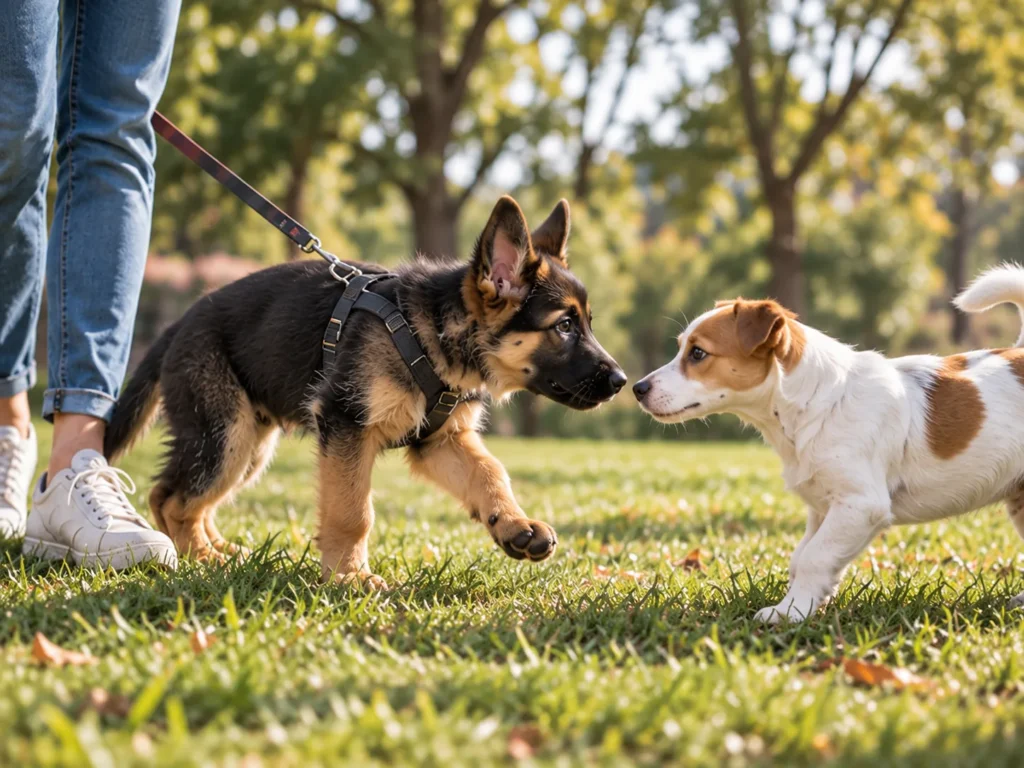
The socialization period is one of the most important developmental windows in a dog’s life.
During these weeks, puppies rapidly learn what is familiar, safe, interesting, or potentially frightening.
View details for “Socializ…”
Different developmental references place the boundaries slightly differently, which is why you may see the socialization period described as ending around 12, 14, or 16 weeks.
The exact final day matters less than the central principle:
Early positive experiences matter.
Physical and Sensory Development
Puppies can now see, hear, walk, run, play, and explore much more effectively.
Coordination improves rapidly, and puppies become increasingly independent as they transition toward solid food and interact more actively with their surroundings.
As mobility improves, their world becomes dramatically larger.
Behavior and Learning
Puppies begin learning from almost everything around them.
They form associations with:
- People
- Other dogs
- Handling
- Household sounds
- Different surfaces
- Objects
- Vehicles
- New environments
- Everyday routines
They also continue learning from their mother and littermates.
Play contributes to physical coordination and communication, while interaction with other puppies can help them practice social signals and bite control.
Fear and Sensitive Periods
Puppies can become particularly sensitive to frightening experiences during parts of early development.
A puppy that hesitates around something unfamiliar does not necessarily need to be pushed toward it.
Instead, give the puppy enough distance to observe, pair the experience with something positive, and allow confidence to develop without overwhelming them.
Socialization is not simply exposure.
Showing a puppy 100 new things is not automatically useful if those experiences are frightening or stressful. The goal is to help puppies develop positive or neutral associations with the kinds of people, animals, environments, handling, sounds, and situations they are likely to encounter later in life.
Early Training
Short, positive training sessions can begin during puppyhood.
Useful early skills include:
- Responding to their name
- Coming when called
- Beginning house-training routines
- Comfortable handling of paws, ears, and mouth
- Settling calmly
- Walking with a leash and harness
- Simple cues such as sit
Training at this age should be brief and rewarding.
The goal is not perfect obedience. It is teaching the puppy that learning and interacting with people can be safe and worthwhile.
Socialization and Vaccination
One common concern is how to socialize a puppy before the initial vaccination series is complete.
Disease prevention matters, but completely isolating a puppy throughout the early socialization period can also mean missing valuable learning opportunities.
The American Veterinary Society of Animal Behavior (AVSAB) supports appropriate socialization before puppies are fully vaccinated when disease risk is managed carefully.
What is appropriate depends on the puppy’s vaccination status, health, and local disease risk, so owners should discuss safe socialization with their veterinarian.
Controlled experiences—such as meeting healthy, appropriately vaccinated dogs or attending well-managed puppy classes when considered suitable—can help puppies learn while reducing unnecessary exposure.
Juvenile Puppy Stage: 3 to 6 Months
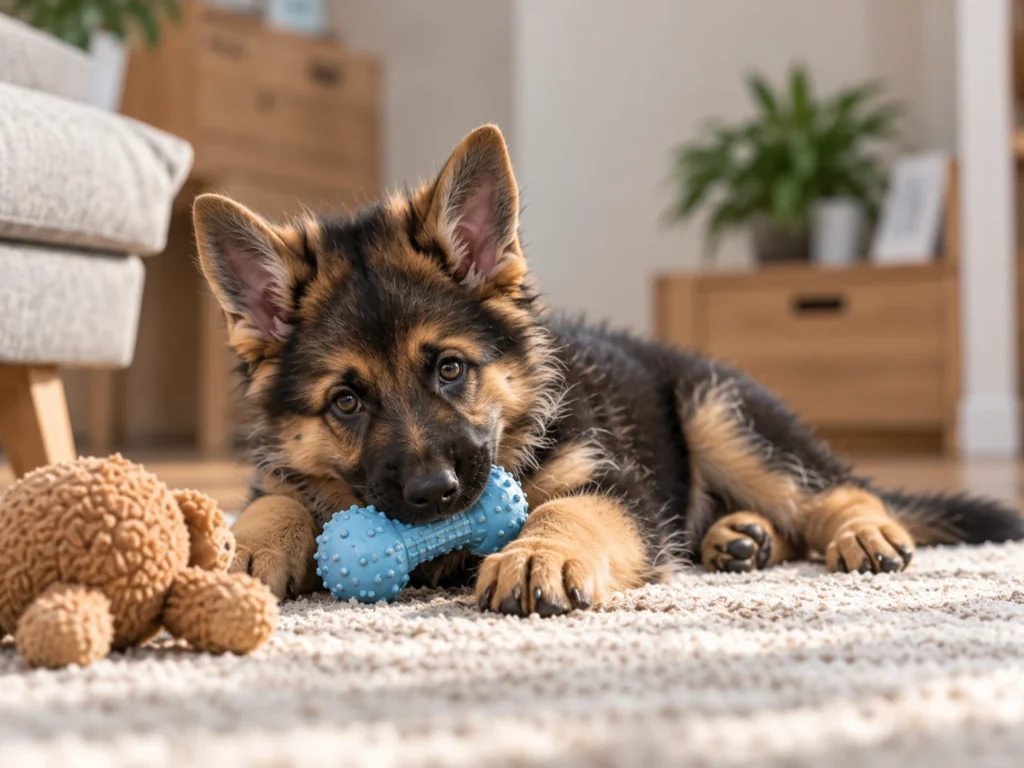
Between roughly three and six months, puppies become stronger, faster, more curious, and increasingly independent.
This is also when many owners discover that the tiny puppy who followed them everywhere suddenly has plenty of opinions.
View details for “Juvenile…”
Rapid Physical Growth
Growth continues quickly, although the rate varies considerably by breed.
A small-breed puppy may already be approaching adult size while a large-breed puppy still has a substantial amount of growing left to do.
Nutrition remains important during this period. Puppies should receive a complete diet appropriate for growth and their expected adult size.
Large-breed puppies have particular nutritional considerations because controlled growth and appropriate nutrient balance are important for developing bones and joints.
Teething
One of the biggest milestones during this stage is the transition from baby teeth to adult teeth.
Puppy teeth commonly begin falling out at around 3–4 months, and by approximately 6 months, most puppies should have most or all of their adult teeth.
Chewing often increases during this period.
Providing safe, appropriate chew options can help redirect chewing away from shoes, furniture, and other household objects.
Check your puppy’s mouth periodically. Persistent baby teeth, obvious mouth pain, difficulty eating, or other dental concerns should be discussed with a veterinarian.
Behavior and Independence
Your puppy may become:
- More energetic
- More confident
- More easily distracted
- More interested in exploring
- Less automatically focused on you
This does not mean early training has failed.
It means the puppy’s brain, body, and environment are changing.
Continue practicing basic skills in gradually more distracting situations rather than expecting a young puppy to behave like a fully trained adult dog.
Building Everyday Routines
This is a good time to strengthen habits around:
- House training
- Recall
- Leash walking
- Calm greetings
- Handling and grooming
- Rest and settling
- Appropriate chewing
- Comfortable periods alone
Consistency now can make adolescence much easier.
Adolescent Puppy Stage: 6 to 12 Months
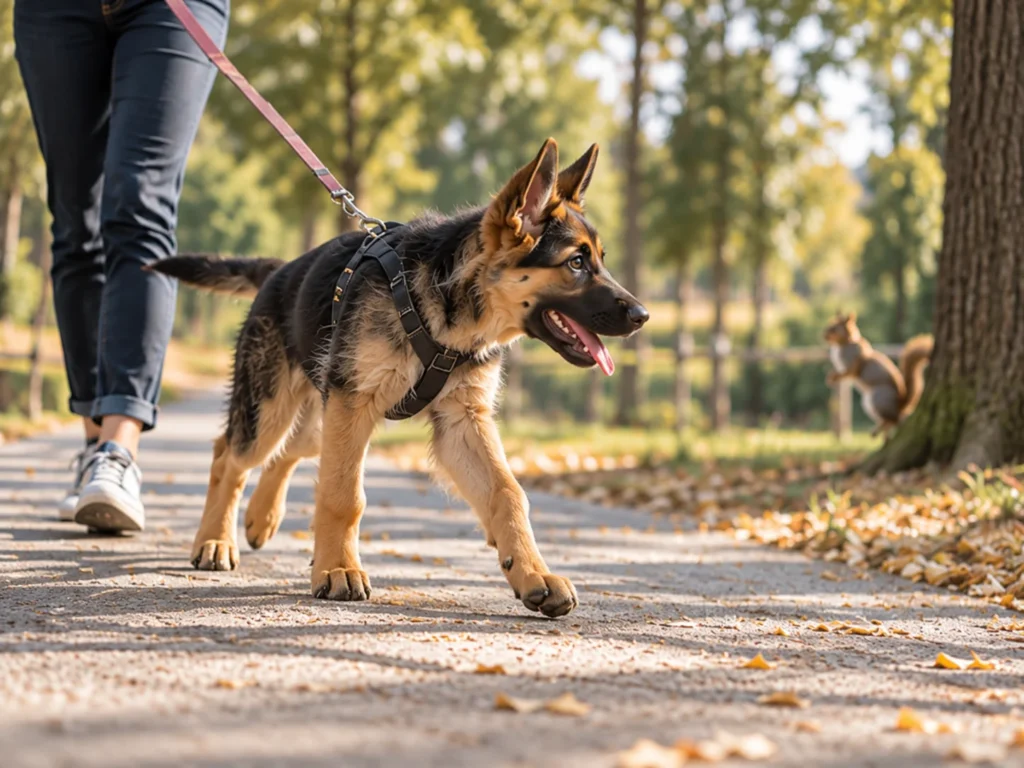
Adolescence can be one of the most challenging parts of puppy development.
A dog may increasingly look like an adult while still having an immature brain and limited self-control.
View details for “Adolesce…”
Physical Changes
Many dogs approach adult height during adolescence, but that does not necessarily mean physical development is complete.
Muscle development, body composition, and skeletal maturation may continue afterward—particularly in larger breeds.
Dogs also reach sexual maturity at different ages.
Importantly, sexual maturity is not the same as complete adulthood.
A dog can be capable of reproduction while still developing physically, behaviorally, and socially.
Behavior
Adolescent dogs often become more independent and distractible.
A puppy that previously responded reliably may suddenly appear to “forget” familiar cues when something exciting happens.
Owners may notice:
- Increased exploration
- Stronger interest in other dogs
- More environmental distractions
- Higher energy
- Testing of established boundaries
- Temporary changes in confidence
This does not mean you need to start training from zero.
It means familiar skills now need to work in a more complicated world.
Keep Training
Continue rewarding the behaviors you want to see.
Practice known skills in different environments and increase difficulty gradually.
Adolescent dogs also need appropriate physical exercise, mental enrichment, opportunities to sniff and explore, and enough rest.
More exercise is not automatically the solution to every behavior problem. An overtired or overstimulated young dog may also struggle to settle.
—
Continued Maturation: 12 to 24 Months
For many dogs, the first birthday marks a noticeable transition toward adulthood.
But development does not necessarily stop at 12 months.
View details for “Continue…”
This is especially important for large and giant breeds, which may continue physical maturation well into their second year.
Physical Development May Continue
A dog can appear close to adult height while muscle, body composition, and skeletal maturity continue developing.
Large and giant breeds generally take longer to complete physical growth than smaller dogs.
This is one reason a universal “every dog becomes an adult at 12 months” rule does not work.
Behavioral Maturity Takes Time
A one-year-old dog may still behave very much like a puppy.
Impulse control, emotional regulation, social behavior, and the ability to settle can continue improving as the dog matures and gains experience.
Training should therefore continue beyond the first birthday.
Adulthood is not graduation from training.
It is a transition from building puppy foundations to maintaining reliable adult habits.
—
When Does a Puppy Become an Adult?
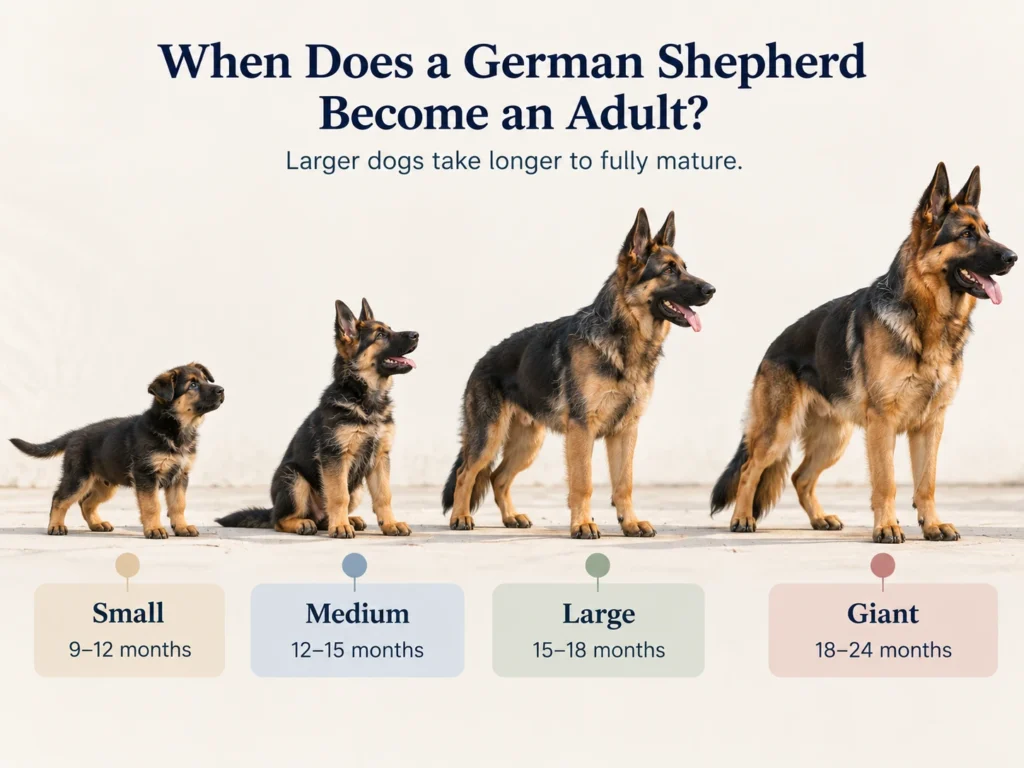
There is no single birthday when every puppy becomes an adult.
The answer depends partly on what you mean by adult. Learn when dogs are considered fully grown adults →
| Type of Maturity | What It Means |
|---|---|
| Sexual maturity | The dog has developed reproductive capability |
| Adult height | Most vertical growth has been completed |
| Skeletal maturity | Bones and growth plates are reaching maturity |
| Behavioral maturity | Behavior and emotional regulation are becoming more adult-like |
| Nutritional adulthood | Growth has slowed enough for an appropriate transition from puppy nutrition |
| Life-stage adulthood | The dog moves from the broader Puppy life stage into Young Adult |
| Expected Adult Size | Approximate Physical Maturity |
|---|---|
| Small | Around 6–8 months |
| Medium | Around 9–12 months |
| Large | Around 12–18 months |
| Giant | Up to around 18–24 months |
View details for “When Doe…”
There Is More Than One Kind of Maturity
These milestones do not necessarily happen at the same time.
That is why one source may describe a dog as leaving puppyhood before another source considers the same dog fully mature.
They may simply be talking about different aspects of development.
How Breed Size Affects Physical Maturity
Smaller dogs generally complete physical growth earlier than larger dogs.
The following ranges are useful general estimates rather than deadlines:
Individual dogs can fall outside these ranges.
Genetics, breed, nutrition, health, and development all influence the timeline.
Instead of asking only:
“Is my dog one year old?”
it is often more useful to ask:
“Which parts of my dog’s development are actually complete?”
A Puppy Can Enter the Young Adult Life Stage Before Being Fully Mature
This distinction is particularly important when using a life-stage framework.
AAHA defines the Puppy life stage as lasting from birth until the end of rapid growth, typically around 6–9 months. After that comes Young Adult, which continues through the completion of physical and social maturation.
So a 10-month-old dog may already fall into the Young Adult life stage while still growing, learning, and behaving very much like a puppy.
Leaving the Puppy life stage does not mean development is finished.
That distinction is one reason Dogsoria separates a dog’s broader life stage from the detailed developmental timeline in this guide.
When Should a Puppy Switch to Adult Food?
The transition from puppy food to adult food should follow the dog’s growth and nutritional needs rather than an arbitrary birthday.
Because smaller and larger breeds mature at different rates, they may transition to adult nutrition at different ages.
Switching too early may remove nutrition intended to support growth, while remaining on a growth diet longer than needed may not suit every dog.
Your veterinarian can help determine the appropriate timing based on breed, expected adult size, growth, body condition, health, and the specific food being used.
—
What Comes After Puppyhood?
Once rapid growth begins to slow, your dog gradually moves into the Young Adult life stage.
But that transition does not mean development suddenly stops.
View details for “What Com…”
Young adult dogs may continue maturing physically and socially while building better impulse control, stronger routines, and more stable adult behavior.
Training, exercise, nutrition, preventive care, and enrichment all continue to matter.
Next: Read the Young Adult Dog Guide to learn what changes after the Puppy life stage.
Not sure which life stage your dog is in?
Use the Dogsoria Dog Age Calculator to see how your dog’s age and size fit into the broader life-stage timeline.
FAQ
Frequently asked questions
What are the main stages of puppy development?
Puppy development is commonly described using the neonatal, transitional, socialization, juvenile, and adolescent stages.
The exact names and age boundaries vary between developmental frameworks, and several stages naturally overlap.
What is the most important puppy development stage?
Every stage matters, but the early socialization period is especially important because puppies are rapidly learning about people, animals, environments, sounds, handling, and everyday experiences.
Good socialization focuses on safe, positive experiences, not simply exposing a puppy to as many things as possible.
When do puppies open their eyes?
Puppies are born with their eyes closed.
Their eyes generally begin opening during the second week of life, although individual development varies. Vision continues developing after the eyes first open.
When do puppies lose their baby teeth?
Puppies commonly begin losing their baby teeth at around 3–4 months.
By approximately 6 months, most puppies should have most or all of their adult teeth.
If baby teeth remain alongside adult teeth or your puppy has obvious mouth pain or difficulty eating, contact your veterinarian.
When does the puppy socialization period end?
Different developmental references use slightly different boundaries, commonly placing the most sensitive early socialization period within approximately the first three to four months of life.
Do not treat a particular week as a hard deadline.
Positive social learning should begin early and continue throughout puppyhood and adulthood.
Additional FAQ content to review
At what age is a dog no longer a puppy?
It depends on what “puppy” means in context.
In everyday language, dogs are often called puppies throughout much of their first year. Veterinary life-stage frameworks may use different boundaries based on growth and care needs.
AAHA defines the Puppy life stage as lasting until the end of rapid growth, typically around 6–9 months, while physical and social maturation can continue much longer.
Do large-breed puppies develop more slowly?
Large and giant breeds generally take longer to complete physical and skeletal development than smaller dogs.
A small dog may approach physical maturity within its first year, while a giant breed may continue developing into its second year.
When should a puppy start eating adult dog food?
There is no single age that applies to every puppy.
The right time depends on breed, expected adult size, growth, body condition, health, and the diet being fed.
Ask your veterinarian when your individual dog should transition from a growth diet to adult maintenance food.
SOURCES
Sources & scientific references
- AAHA (American Animal Hospital Association)
- AVSAB (American Veterinary Society of Animal Behavior)
- AKC (American Kennel Club)
- Other Veterinary & Animal Welfare Resources
- VCA Animal Hospitals:When to Switch a Puppy to Adult Food
- Best Friends Animal Society:Puppy Development Stages From Birth to Two Years Old
MORE FROM THIS CATEGORY