
Dog Breeds Guide
Why Do Dachshunds Bark So Much? 7 Causes and Training Solutions
Dachshunds have a reputation…

QUICK ANSWER
The short answer
Yes, Dachshunds are naturally vocal dogs. Their hunting background, alertness, independence, and prey drive can make them quicker to bark than many owners expect.
However, excessive barking can also be caused by boredom, fear, frustration, attention-seeking, separation-related distress, or even pain.
Overview
But breed instinct is only part of the story. If your Dachshund seems to bark at every person, dog, delivery truck, window sound, or moment you leave the house, there is usually a more specific trigger behind it.
The useful question is not simply: “How do I make my Dachshund stop barking?” It is: “What is causing this bark, and what should I teach my dog to do instead?”
Important planning details
The goal should not be to turn your Dachshund into a completely silent dog. Instead, identify what triggers the barking, prevent your dog from repeatedly practicing the behavior, and reward a calmer response.
That cause-first approach is important because the solution for a Dachshund barking at a squirrel outside the window is very different from the solution for one panicking when left alone. This is also one of the biggest weaknesses in many existing barking guides: they list causes and training tips, but do not clearly connect each trigger to its appropriate response.
Why Do Dachshunds Bark More Than Other Dogs?

Your Dachshund is not barking because they are being deliberately difficult. Some of the traits that make the breed so charming can also make barking easier to trigger.
1. They Were Bred to Hunt
View details for “Why Do D…”
“Dachshund” translates roughly to “badger dog.” These low, long-bodied dogs were developed in Germany to pursue quarry, including badgers, into underground dens. That work required courage, persistence, scenting ability, and the confidence to operate away from a handler. A modern Dachshund may spend more time investigating the space under your blanket than a badger burrow, but that independent hunting mindset is still part of the breed.
2. They Were Expected to Make Noise
For a dog working underground, vocalization had a practical purpose. A hunter standing above ground needed to know where the dog was. AKC’s Earthdog history specifically notes the value of a piercing bark that could help people locate a working Dachshund underground. Today, the “important news” your Dachshund reports may be less dramatic:
- a package being delivered,
- footsteps in the hallway,
- a neighbor closing a car door,
- a squirrel on the fence,
- or apparently nothing you can see at all.
To your Dachshund, however, announcing those events may feel completely reasonable.
3. They Notice Movement and Changes Quickly
Dachshunds are scent hounds with strong hunting instincts. A dog bred to notice and pursue small animals is naturally likely to pay attention to movement, unfamiliar smells, and environmental changes. That does not mean every Dachshund will bark constantly. Personality, early experiences, training, environment, and reinforcement all matter. It simply means you may be starting with a dog that is genetically very willing to sound the alarm.
7 Common Reasons Dachshunds Bark So Much
Before trying to stop the noise, look at when it happens. The moment immediately before your Dachshund starts barking often tells you more than the bark itself.
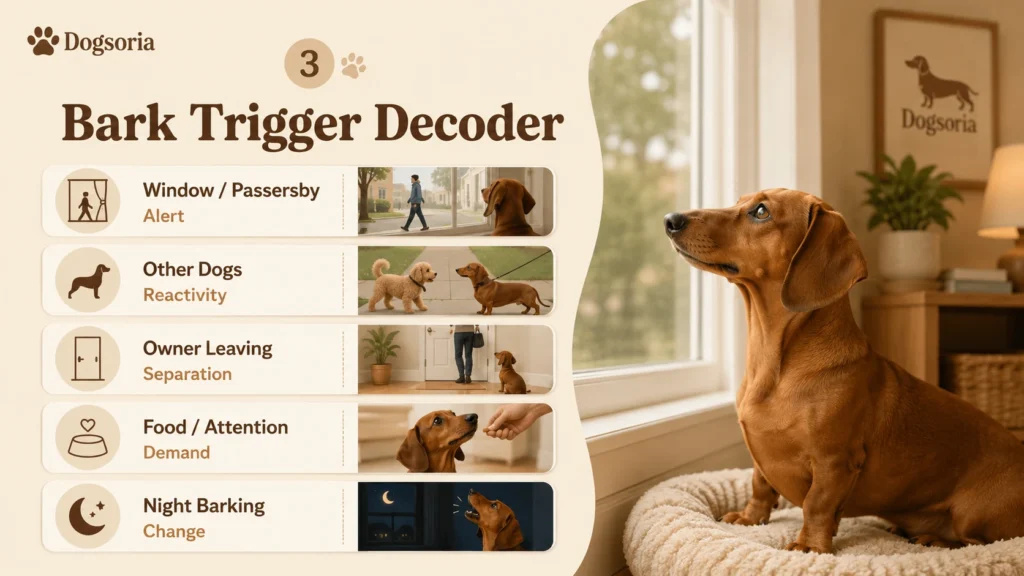
1. Alert and Territorial Barking
View details for “7 Common…”
This is classic Dachshund behavior. Your dog hears something outside, rushes to the window, stiffens, and lets everyone know that an unauthorized Amazon driver has entered the kingdom.
Common triggers include:
- people walking past the house,
- delivery drivers,
- visitors,
- doorbells,
- cars pulling into the driveway,
- dogs passing a window,
- sounds in an apartment hallway.
A few alert barks are not necessarily a problem. The issue is when your Dachshund becomes stuck in the behavior—running from window to window, barking for long periods, or being unable to settle after the trigger is gone.
For this type of barking, environmental management is often more effective than repeatedly shouting “quiet.” Close the curtain. Use privacy film on a problem window. Move a favorite lookout bed away from the front door. Then reward your dog for noticing a trigger and disengaging from it. You are not “giving up” by managing the environment. You are stopping your dog from rehearsing the same barking routine dozens of times every day.
2. Hunting Instinct and Prey Drive
A Dachshund staring at a squirrel is not necessarily feeling territorial. Sometimes the ancient hunting software has simply switched on.
Common triggers include:
- squirrels,
- rabbits,
- birds,
- cats,
- rustling bushes,
- fast-moving objects.
You may see intense staring, leaning forward, pulling, whining, or trying to chase along with the barking. In this situation, yelling at your dog for barking does nothing to change how exciting the trigger is. Instead, create enough distance that your Dachshund can notice the animal without losing the ability to think. Reward your dog for turning back toward you, sniffing for scattered treats, or moving away with you.
3. Boredom and Unused Energy
A bored Dachshund can become a professional neighborhood surveillance officer. If nothing interesting is happening inside the house, every sound outside suddenly becomes an event.
Boredom-related barking may occur alongside:
- following you constantly,
- chewing inappropriate objects,
- digging,
- repeatedly demanding interaction,
- wandering from window to window,
- difficulty settling.
Physical exercise helps, but “just tire your dog out” is incomplete advice. Dachshunds are scent-driven dogs, so mental enrichment can be extremely useful too.
Try:
- sniff walks,
- food puzzles,
- scatter feeding,
- hide-and-seek with treats,
- short training sessions,
- safe chew activities,
- scent games around the house.
Ten focused minutes of sniffing and problem-solving may sometimes produce a calmer dog than another ten minutes of simply walking around the block.
4. Attention-Seeking or Demand Barking
This one can be accidentally trained surprisingly fast. Your Dachshund barks. You look at them. They bark again. You say, “What do you want?” Congratulations: from your dog’s perspective, barking worked.
Demand barking commonly happens when a Dachshund wants:
- food,
- play,
- access to the couch,
- a door opened,
- your attention,
- something another person is holding.
The important part is not simply to “ignore barking.” Instead, teach your Dachshund what behavior does work. For example, if your dog normally barks while you prepare dinner, teach them to settle on a mat nearby. Quietly reward the mat behavior before barking begins.
You are replacing: Bark -> human responds with: Settle quietly -> good things happen.
5. Fear or Reactivity
Not every barking Dachshund is confidently defending the neighborhood. Some are barking because they want something to stay away.
A reactive Dachshund might bark at:
- unfamiliar dogs,
- strangers,
- children,
- bikes,
- unfamiliar noises,
- visitors approaching directly.
Look at the whole body rather than assuming the bark means aggression. Signs your dog is struggling can include:
- stiff posture,
- backing away,
- lunging,
- tucked tail,
- repeated scanning,
- inability to eat treats,
- inability to respond to familiar cues.
Reactivity and aggression are not interchangeable terms. A dog barking and lunging on leash might be afraid, frustrated, over-aroused, or attempting to create distance. If your Dachshund cannot take food or look away from the trigger, you are probably too close for productive training. Create distance first. Train second.
6. Separation-Related Distress
A Dachshund barking after you leave is not automatically experiencing separation anxiety. Some dogs bark briefly and then settle. Others are bored by noises outside.
True separation-related distress usually involves a larger pattern. The ASPCA lists persistent barking or howling alongside behaviors such as pacing, destruction, elimination, escape attempts, and distress around departure as possible signs of separation anxiety. These behaviors often start soon after the owner leaves.
A simple home camera can be extremely useful. Watch what your Dachshund actually does during the first 20–30 minutes after you leave. A dog who barks at a passing truck and then sleeps is telling you something very different from a dog who paces continuously, pants, scratches the door, refuses food, and cannot settle.
For suspected separation distress, do not rely on “letting them bark it out.” The underlying emotional problem needs to be addressed.
7. Pain, Hearing Changes, or Senior-Dog Changes
A sudden change in barking deserves more attention than a lifelong noisy personality. The ASPCA advises ruling out illness or injury when dealing with problematic barking because dogs may vocalize in response to pain.
Contact your veterinarian if your Dachshund suddenly starts barking more and you also notice:
- reluctance to move,
- crying when picked up,
- sensitivity to touch,
- difficulty using stairs,
- restlessness,
- disrupted sleep,
- unusual hiding,
- confusion.
This deserves particular attention in Dachshunds because the breed is susceptible to spinal problems such as Dachshund IVDD. You can also monitor your dog’s aging milestones using a Dog Age Calculator to better understand senior behavioral shifts.
Senior dogs can also become more vocal as hearing, vision, sleep patterns, anxiety, or cognitive function change. ASPCA guidance on older dogs specifically notes that excessive or nighttime vocalization may warrant evaluation for medical or behavioral causes. If an older Dachshund suddenly starts wandering and barking at 2 a.m., do not immediately treat it as a training failure.
What Is Your Dachshund Trying to Tell You?
Use the situation around the bark as your first clue.
| When your Dachshund barks | Possible cause | What else you may notice | Start here |
|---|---|---|---|
| People pass the window | Alert/territorial barking | Staring, rushing to window | Block some visual access and reward disengagement |
| You leave the house | Separation-related distress | Pacing, panting, scratching doors | Record the behavior and assess the full pattern |
| Another dog approaches | Fear/reactivity or frustration | Lunging, staring, won’t take food | Increase distance |
| You prepare food | Demand barking | Staring, pawing, following | Teach a mat behavior and reward quiet waiting |
| A squirrel appears | Prey drive | Tracking, pulling, intense focus | Increase distance and reward turning away |
| Suddenly at night | Environmental or medical change | Restlessness, confusion | Track the pattern; consider a veterinary check |
There is no perfect one-bark diagnosis. Use the table as a starting point, then look for patterns over several days.
How Much Barking Is Normal for a Dachshund?
There is no medically meaningful number of “acceptable barks per day.” Instead, ask:
- What triggers the barking?
- How long does it continue?
- Can my dog disengage?
- How quickly do they recover afterward?
- Does barking interfere with sleep or normal family life?
- Does my dog appear distressed?
- Is the behavior becoming more frequent?
A Dachshund giving three or four alert barks when someone knocks at the door is very different from a Dachshund spending ten minutes pacing and barking after the visitor has gone. The second dog is having much more difficulty regulating their response.
How to Reduce Excessive Dachshund Barking: A 5-Step Plan
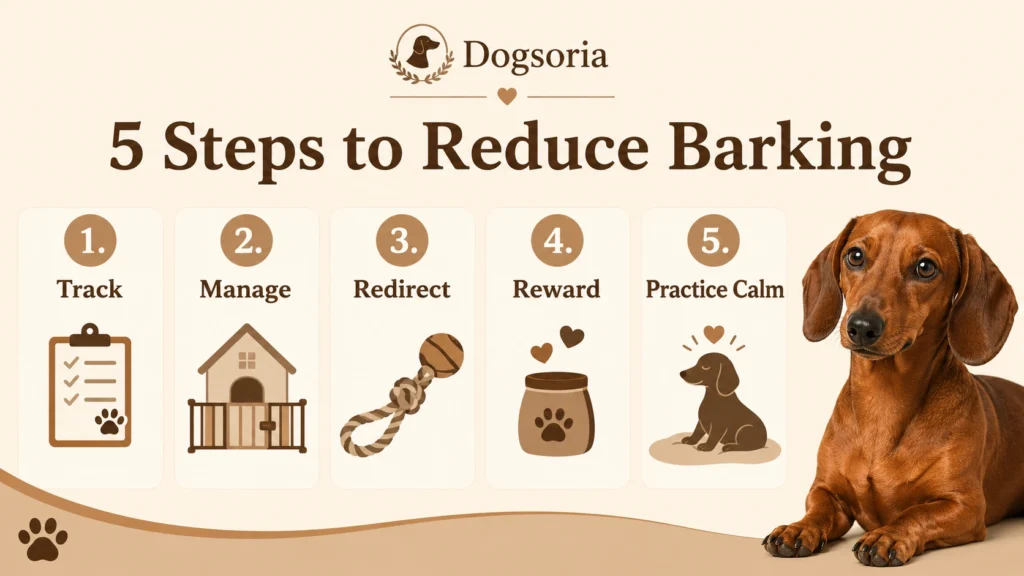
Step 1: Keep a Three-Day Bark Log
For three days, stop guessing. Write down:
View details for “How to R…”
- time,
- location,
- trigger,
- duration,
- body language,
- what your dog did immediately before barking,
- what you did immediately afterward.
You may discover patterns surprisingly quickly. Perhaps 70% of the barking happens from one window. Maybe it happens during the same hour every afternoon. Or perhaps your Dachshund only barks when left alone after seeing you pick up your keys. Once you know the pattern, training becomes much easier.
Step 2: Stop Rehearsing the Behavior
Every successful repetition can strengthen a routine. Your dog sees someone. They bark. The person disappears. From your Dachshund’s perspective: “Excellent. Barking worked again.”
Reduce unnecessary repetitions while you train. That might mean:
- closing curtains,
- using privacy film,
- playing white noise,
- keeping your dog away from the front window,
- walking at quieter times,
- increasing distance from other dogs.
Management and training work together.
Step 3: Teach an Alternative
“Don’t bark” leaves a behavioral vacuum. Give your Dachshund something clear to do instead. Useful alternatives include:
- Go to your mat.
- Look at me.
- Find it.
- Come away from the window.
- Settle beside me.
Start teaching these behaviors when nothing exciting is happening. Do not wait for your Dachshund to be at maximum volume before introducing the lesson.
Step 4: Reward the Quiet Moment
One of the easiest mistakes is focusing entirely on barking. Start noticing silence.
If your Dachshund hears a sound, lifts their head, but does not bark: reward that. If they see someone outside and turn back toward you: reward that. If they bark twice and then pause: you have a small training opportunity.
Mark the quiet moment with a consistent word such as “yes,” then reward. As the behavior becomes predictable, you can begin associating a cue such as “quiet” with the calm pause.
Trainer’s Tip: The most useful moment is often before the bark. If your Dachshund can see the trigger, still take food, and still respond to you, learning is much easier.
Step 5: Stay Below Your Dog’s Threshold
Imagine your Dachshund sees another dog 100 feet away and calmly eats a treat. At 50 feet, they stare but can still respond to you. At 15 feet, they explode into barking and lunging. Fifteen feet is not where you should begin training.
Start where your dog can succeed. Signs you may be too close to a trigger include:
- refusing treats,
- freezing,
- hard staring,
- body stiffness,
- repeated lunging,
- continuous barking,
- inability to respond to familiar cues.
Increase distance until your Dachshund can think again.
What to Do in Common Barking Situations

Barking at the Window
Start with the environment. Prevent hours of window patrol by partially blocking the view or moving furniture. Then practice: See person -> turn toward you -> reward.
View details for “What to …”
Your goal is not to convince your Dachshund that pedestrians no longer exist. You are teaching: “You noticed it. I noticed it too. You can disengage now.”
Barking at the Doorbell
Practice with a helper at low intensity rather than waiting for a real delivery. Teach: doorbell -> go to mat -> reward.
Begin with a quiet recording or soft knock if a normal doorbell causes an immediate explosion. Increase difficulty gradually.
Barking at Other Dogs on Walks
Do not keep walking directly toward another dog to “make them get used to it.” If your Dachshund is already reacting, create space. Practice at a distance where your dog can look at the other dog and still eat. Reward calm observation and voluntary check-ins with you.
Barking When Home Alone
Use a camera. This is one of the few situations where guessing can seriously mislead you. If your dog barks briefly and settles, environmental management may help. If your dog shows persistent barking together with pacing, panting, escape attempts, destruction, or inability to eat, speak with your veterinarian or a qualified behavior professional about separation-related distress. Crates are also not automatically the answer. The ASPCA notes that crates can help some dogs but may increase stress in dogs who panic when confined.
Barking at Night
First ask what changed. Could your Dachshund hear animals or people outside? Do they need to toilet? Has the sleeping environment changed? Are they uncomfortable? For a senior dog, new nighttime barking accompanied by pacing, confusion, or restlessness deserves veterinary attention rather than simply stricter training.
A Simple 7-Day Barking Training Plan
This is a starter plan, not a promise that barking will disappear in seven days.
| Day | Focus |
|---|---|
| Day 1 | Record your Dachshund’s major barking triggers |
| Day 2 | Reduce the easiest trigger in the environment |
| Day 3 | Reward calm behavior before barking starts |
| Day 4 | Teach a mat, “find it,” or check-in behavior |
| Day 5 | Practice around one low-intensity trigger |
| Day 6 | Increase difficulty slightly while your dog stays calm |
| Day 7 | Review the log and identify what is improving |
If Day 5 goes badly, do not rush to Day 6. Lower the difficulty and repeat. Behavior change is not a straight line.
Puppy vs. Adult vs. Senior Dachshund Barking
Dachshund Puppies
With puppies, prevention matters. Use early positive experiences to teach that:
View details for “Puppy vs…”
- strangers are normal,
- household noises are normal,
- other dogs do not always require a reaction,
- quiet behavior earns attention too.
Avoid deliberately overwhelming a puppy in the name of “socialization.” Good socialization should build confidence, not force interaction. If you are preparing for a new pup, budgeting for training and early healthcare is essential—learn more about expected costs in How Much Does a Dachshund Cost?.
Adult Dachshunds
Adults may already have hundreds or thousands of repetitions behind a barking habit. That does not mean training cannot work. It usually means you need more consistency with:
- trigger management,
- alternative behaviors,
- reinforcement,
- gradual exposure.
In addition to training, understanding coat variations and maintenance—such as checking Do Dachshunds Shed?—can help minimize daily environmental stressors during grooming sessions.
Senior Dachshunds
Do not assume new barking is simply stubbornness. Older dogs can experience pain, sensory changes, anxiety, disrupted sleep, and cognitive changes. A sudden behavioral change deserves a health check first. As Dachshunds enter their golden years—you can check How Long Do Dachshunds Live? for typical lifespan milestones—new vocalization is often tied to vision changes, joint pain, or cognitive shifts.
What Not to Do When Your Dachshund Barks
Don’t Yell Over the Barking
Adding another loud voice rarely creates calm. It may increase excitement, and your dog may not understand what the yelling is supposed to mean.
View details for “What Not…”
Don’t Punish Fear
If your Dachshund is barking because they feel unsafe, adding pain, intimidation, or fear does not address the underlying emotion. AVSAB’s current position recommends reward-based training for dog training and behavior modification and advises against aversive methods such as electronic collars, prong collars, choke chains, leash corrections, and physical or psychological punishment.
Don’t Let Severe Separation Distress “Burn Itself Out”
A frightened dog is not practicing independence simply because nobody responds. If you see panic-like behavior, treat it as an emotional problem rather than a battle of wills.
Don’t Expect a Silent Dachshund
Your Dachshund is allowed to communicate. Success might mean:
- two alert barks instead of twenty,
- returning to you when called,
- recovering faster,
- seeing another dog without exploding,
- settling after a noise.
That is meaningful progress.
Final Thoughts
Dachshunds were never designed to be quiet little ornaments. They are alert, persistent hunting dogs packed into a very small body, so some barking comes naturally. But “Dachshunds bark a lot” should not become an excuse for nonstop barking that leaves both you and your dog stressed. Start with the trigger. Watch what happens immediately before the bark. Notice your dog’s body language. Reduce unnecessary exposure, reward calmer choices, and teach a behavior your Dachshund can perform instead. You do not need a perfectly silent Dachshund. You want one who can notice the world—and then settle again.
When Should You Call a Vet or Behavior Professional?
Talk with your veterinarian if your Dachshund:
- suddenly begins barking much more than usual,
- cries or barks when touched or picked up,
- seems painful or reluctant to move,
- starts barking or pacing during the night,
- appears confused,
- shows other sudden behavioral changes.
Seek qualified behavioral help if your dog:
- panics when left alone,
- tries to escape and may hurt themselves,
- cannot function around certain triggers,
- has attempted to bite,
- continues getting worse despite careful training.
For Dachshunds, sudden pain-related behavior deserves particular attention because back problems are common in the breed. Related Dogsoria guide: Dachshund IVDD: Early Symptoms, Emergency Signs, Treatment, and Prevention.
FAQ
Frequently asked questions
Are Dachshunds naturally barky?
Yes. Dachshunds were developed as bold, independent hunting dogs, and vocalization was useful during hunting work. Individual dogs still vary considerably, and training and environment influence how much they bark.
Can you train a Dachshund not to bark?
You can usually reduce excessive barking and teach better responses to triggers, but expecting a Dachshund never to bark is unrealistic. Focus on calm recovery and appropriate communication rather than complete silence.
Why does my Dachshund bark at everything?
Your dog probably does not perceive everything as the same trigger. Keep a short barking log and separate the events into categories such as people outside, animals, unfamiliar sounds, attention-seeking, fear, or being left alone. Different causes need different solutions.
Why does my Dachshund bark when I leave?
Brief barking can have several causes. Persistent barking accompanied by pacing, panting, destruction, escape attempts, or other distress may indicate separation-related anxiety and deserves closer assessment.
Why does my Dachshund bark at night?
Environmental noises, toileting needs, discomfort, anxiety, or medical changes can all contribute. New nighttime barking in an older Dachshund—especially with restlessness or confusion—should be discussed with a veterinarian.
Additional FAQ content to review
Should I ignore my Dachshund when they bark?
Not automatically. Ignoring may prevent attention-seeking barking from being rewarded, but it does not solve fear, territorial triggers, separation distress, or pain. First identify why your dog is barking.
Do Miniature Dachshunds bark more than Standard Dachshunds?
There is not enough reliable evidence to say that miniature Dachshunds inherently bark more than standards. Individual temperament, learning history, socialization, lifestyle, and environment are more useful factors to consider.
How long does it take to reduce Dachshund barking?
There is no universal timeline. A simple demand-barking habit may improve relatively quickly when reinforcement changes. Fear, reactivity, or separation-related problems can require much longer, gradual work. Measure progress by whether your Dachshund reacts less intensely, recovers faster, and can respond to you around previously difficult triggers.
SOURCES
Sources & scientific references
- American Kennel Club — Dachshund History: AKC Dachshund History — Supports Dachshund hunting history, independent work, and breed background.
- American Kennel Club — Dachshund Facts: AKC Dachshund Facts — Supports specific breed characteristics and badger hunting origins.
- ASPCA — Barking Guide: ASPCA Barking Guide — Provides insights on identifying causes and managing excessive barking.
- ASPCA — Common Dog Behavior Issues: ASPCA Common Behavior Issues — Offers behavioral guidance on various functions of barking.
- ASPCA — Separation Anxiety: ASPCA Separation Anxiety — Reference for home alone distress and separation behavior patterns.
- ASPCA — Behavior Problems in Older Dogs: ASPCA Older Dog Behavior Problems — Reference for senior Dachshund vocalization and cognitive shifts.
- American Veterinary Society of Animal Behavior: AVSAB Position Statements — Supports reward-based training and advises against aversive methods.
MORE FROM THIS CATEGORY