
Dog Breeds Guide
Dachshund IVDD: Early Symptoms, Emergency Signs, Treatment, and Prevention
Dachshunds are highly prone …
Dachshunds are more likely than many breeds to develop intervertebral disc disease (IVDD), a spinal condition that can cause pain, weakness, trouble walking, and—in severe cases—paralysis.
Overview
The key is not to panic over every missed jump. It is to notice unusual changes early and know when your dog needs help now.
If your Dachshund suddenly cannot walk, drags a paw, loses use of the back legs, cannot urinate normally, or appears to be in severe pain, contact an emergency veterinarian immediately. IVDD can progress quickly, and prompt assessment can affect treatment decisions and recovery.
Go to an emergency vet now if your Dachshund:
- Cannot stand or walk normally
- Drags a paw or walks on the top of a foot
- Suddenly loses use of one or both back legs
- Cannot urinate, leaks urine, or loses bowel control
- Cries repeatedly, shakes, or appears to be in severe pain
Why Are Dachshunds Prone to Back Problems?
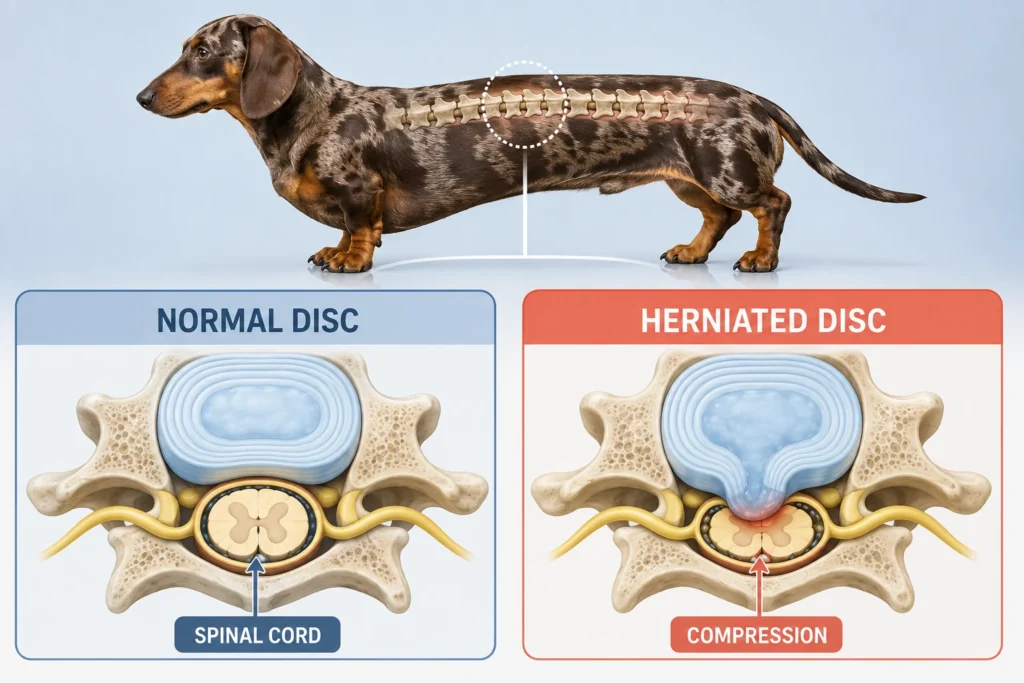
Between the bones of your dog’s spine are intervertebral discs. You can think of them as small cushions: they help the back bend, absorb impact, and move comfortably.
In Dachshunds, these discs can degenerate earlier than in many other dogs. A weakened disc may bulge or rupture, placing pressure on the spinal cord and nerves. This is called IVDD.
View the detailed explanation and practical steps
Dachshunds are one of the breeds most commonly affected. Signs may first appear in young adulthood, often around ages three to six, although IVDD can occur at other ages too. Cornell University College of Veterinary Medicine
However, IVDD is not the only possible cause of back pain or weakness. Injury, arthritis, muscle strain, and other neurological conditions can sometimes look similar. That is why a new change in movement, pain, or coordination deserves veterinary advice rather than a guess at home.
It is also unfair to blame every episode on one jump off the sofa. A jump, awkward landing, or slip may trigger symptoms, but the disc may already have been changing over time.
Early Signs of IVDD: What You May Actually Notice at Home
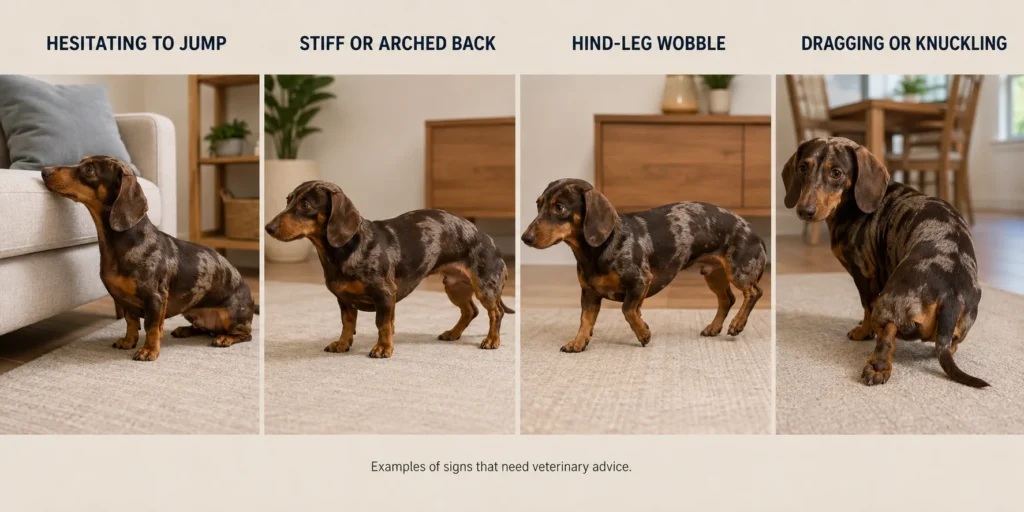
Some Dachshunds cry out suddenly. Others give quieter clues that can be mistaken for laziness, stubbornness, or simply getting older.
| What you may notice | What it can look like at home |
|---|---|
| Less willing to move | Hesitates before walks, stairs, or getting onto the sofa |
| Pain or discomfort | Shaking, tense belly, arched back, or a sudden yelp when picked up |
| Stiff movement | Walking slowly, avoiding turns, holding the head low |
| Hind-leg weakness | Wobbling, slipping, crossing back feet, or difficulty standing |
| Paw changes | Knuckling over, dragging toes, or unusually worn back nails |
| Behavior changes | Hiding, resisting touch, growling, or snapping when normally gentle |
| Toilet changes | Struggling to urinate, leaking urine, or loss of bowel control |
View the detailed explanation and practical steps
A small change can matter. Maybe your dog still wants to go for a walk, but stops after a few steps. Maybe they used to jump onto the bed and now simply stand beside it. That does not automatically mean IVDD—but it can mean something is uncomfortable.
> Dogsoria Quick Check > > Still walking, but painful or stiff? Limit activity and contact your vet the same day. > Wobbling, falling, or dragging paws? Treat it as urgent. > Unable to walk or urinate normally? Go to an emergency vet.
【Dogsoria 风格:把 “ataxia”“neurological deficit” 这种术语,翻译成主人真正会看到的生活细节。】
What to Do If You Suspect IVDD
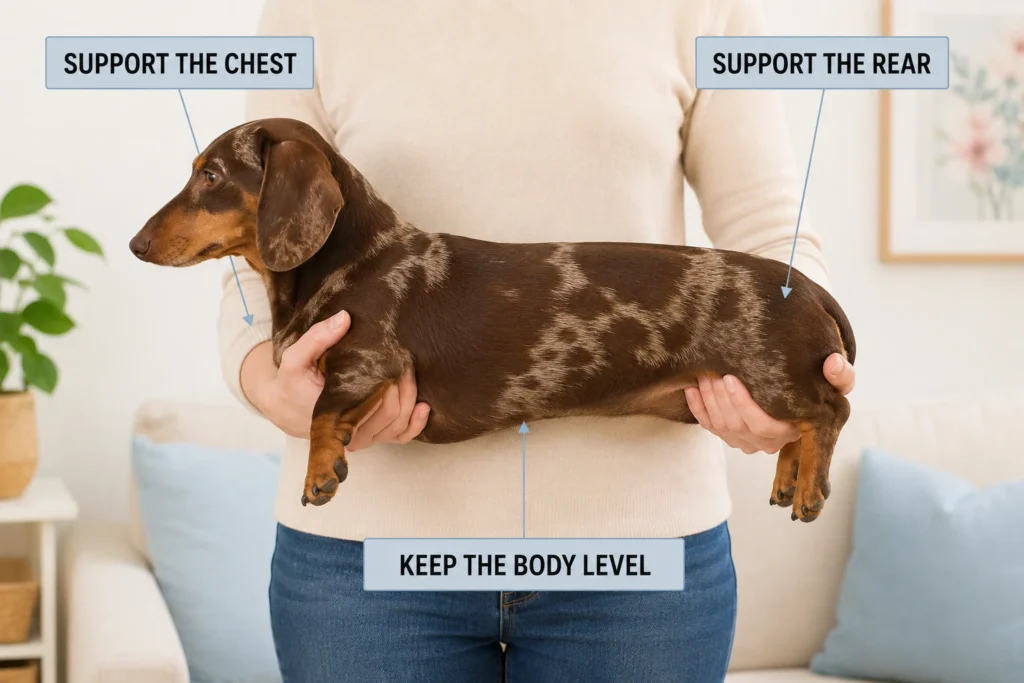
If your Dachshund develops possible IVDD symptoms, do not test whether they can “walk it off.” Your first job is to prevent unnecessary movement and get professional advice.
- Restrict activity immediately. Stop running, jumping, stairs, rough play, and furniture access.
View the detailed explanation and practical steps
- Carry your dog carefully. Support both the chest and rear end. Keep their body as level as possible rather than letting the back hang.
- Use a crate or small recovery space. This reduces the chance of a sudden jump or twist while you arrange care.
- Call your vet or an emergency clinic. Explain when the signs began and whether walking, pain, or urination has changed.
- Do not give human pain medicine. Medications such as ibuprofen, naproxen, and acetaminophen can be dangerous for dogs.
- Do not massage, stretch, or “adjust” the spine. Until a veterinarian knows what is causing the pain, home manipulation may make an injury worse.
Dogsoria Safety Note: “My dog can still walk” does not mean “it is safe to wait several days.” A dog can still be mobile while experiencing significant pain or early nerve problems.
Recovery Care After an IVDD Episode
Recovery often takes weeks or months, not days. This can be frustrating because your Dachshund may look happier before their body is ready to return to normal activity.
Follow your veterinarian’s instructions around rest, medication, and controlled exercise. Depending on your dog’s condition, recovery may include:
View the detailed explanation and practical steps
- A quiet recovery area with non-slip flooring
- Soft bedding and regular repositioning if mobility is limited
- Help with toileting or bladder care, after your veterinary team has shown you how
- Short, controlled leash walks only when approved
- Rehabilitation or physical therapy when recommended
Call your veterinarian promptly if pain returns, walking becomes worse, your dog stops eating, or urination changes.
Can You Prevent IVDD in Dachshunds?
You cannot remove IVDD risk completely. Genetics and early disc degeneration play a real role in this breed.
But you can reduce avoidable strain on your Dachshund’s spine:
View the detailed explanation and practical steps
- Keep your dog at a healthy body weight.
- Use ramps or pet steps for beds, sofas, and cars when practical.
- Add rugs or non-slip runners to slick floors.
- Reduce repetitive, high-impact jumping, especially when chasing toys.
- Choose regular walks and controlled play over frequent leaping and rough tumbles.
- Use a well-fitted harness rather than putting pulling pressure on the neck.
- Contact your vet early when something feels different.
Dogsoria Reality Check: A ramp is useful, but it is not a magic shield against IVDD. The realistic goal is healthier daily movement, a healthy weight, and faster action when your dog shows pain or weakness—not raising a Dachshund who is afraid to move.
Common IVDD Myths
“My Dachshund is too young to have IVDD.”
Not necessarily. Predisposed breeds can develop IVDD signs in young adulthood.
View the detailed explanation and practical steps
“If my dog can walk, it cannot be serious.”
Not true. Pain, wobbling, or dragging paws can worsen even if your dog is still mobile.
“One ramp means my dog will never get IVDD.”
A ramp can reduce repeated impact from furniture, but it cannot remove genetic or age-related disc risk.
“Back pain always means IVDD.”
No. IVDD is common in Dachshunds, but it is not the only possible cause of pain or weakness. A veterinarian needs to determine what is happening.
The Bottom Line
IVDD is frightening because symptoms can change quickly. But you do not need to panic over every slow walk or missed jump.
Pay attention to changes that are unusual for *your* dog: hesitation before jumping, stiffness, pain when being picked up, wobbling, dragging paws, or toileting changes. Restrict activity, avoid risky home treatments, and contact a veterinarian early.
For sudden weakness, inability to walk, paralysis, or bladder problems, emergency care is the right next step.
How Vets Diagnose and Treat IVDD
Your veterinarian will usually begin with a physical examination and a neurological assessment. In mild cases, this may be enough to guide initial treatment.
X-rays can be useful for ruling out some problems and may show disc calcification, but they do not always identify the exact disc causing spinal cord compression. For more serious cases, your vet may recommend referral and advanced imaging such as CT or MRI. These tests can help locate the affected area and guide treatment. Cornell’s IVDD guide
Conservative treatment
Dogs with mild pain and limited neurological signs may be treated with veterinary-guided rest, prescription pain relief, and sometimes muscle relaxants.
Strict activity restriction matters. A dog may seem brighter after medication, but that does not mean the spine is ready for normal play, stairs, or sofa jumping again.
Surgery
Surgery may be recommended when a dog cannot walk, symptoms are worsening, pain is severe, or conservative treatment is not enough. The goal is to remove pressure from the spinal cord.
Surgery is not automatically necessary for every case, and no treatment can promise a perfect recovery. Prognosis depends on several factors, including the degree and location of spinal cord injury. Your veterinary team—not a test at home—should assess neurological function and explain what it may mean for your dog.
The American College of Veterinary Surgeons notes that conservative treatment is generally considered for mild neurological cases, while surgical decompression is often recommended for more serious cases.
FAQ
Frequently asked questions
What is usually the first sign of IVDD in a Dachshund?
Early signs can include reluctance to jump, stiffness, shaking, an arched back, pain when being picked up, or avoiding normal walks. Some dogs become quieter or more irritable before obvious weakness appears.
Can a Dachshund recover from IVDD without surgery?
Some mild cases can improve with veterinary-guided rest, medication, and careful monitoring. Dogs with severe weakness, paralysis, worsening signs, or uncontrolled pain may need surgery. Your vet can help determine the safest option.
Can jumping cause IVDD in Dachshunds?
Jumping may trigger symptoms in a vulnerable disc, but IVDD is usually not caused by one single jump alone. Reducing repeated, high-impact jumping is sensible for a breed already prone to disc disease.
How long does IVDD recovery take?
Recovery varies widely. Mild cases may improve over several weeks, while severe cases or recovery after surgery can take months. Even when a dog seems better, returning to activity too early can be risky.
Can IVDD happen again after recovery?
Yes. A Dachshund can have another disc episode later in life. That is why healthy weight, safer daily movement, and quick action when new symptoms appear still matter after recovery.