
Dog Breeds Guide
How to Stop a Dog From Barking: Identify the Cause and Train the Right Response
The goal: Help your dog feel…
DOGSORIA DOG CARE GUIDE
QUICK ANSWER
The short answer
To reduce excessive barking, first identify why your dog is barking. Manage triggers, reward a calmer alternative, and practice in situations your dog can handle. Barking caused by fear, pain, or separation-related distress needs a different response from barking that reliably earns attention. A dog may bark at a delivery driver, a sound outside, or someone passing the window. Rather than aiming for complete silence, work toward shorter reactions and an easier return to calm. Training should address the cause, not just the noise.
Overview
The goal: Help your dog feel safe, respond to a useful cue, and settle when the situation allows—not eliminate normal canine communication.
Key Takeaways
- Identify the trigger and check for unmet needs or health concerns before training.
- Reduce repeated exposure to triggers while teaching an alternative response.
- Reward quiet moments and calm choices promptly; increase difficulty gradually.
- Do not ignore barking associated with fear, pain, anxiety, or distress.
- Seek professional help for severe reactions, separation-related panic, or sudden changes in barking.
Why Do Dogs Bark?
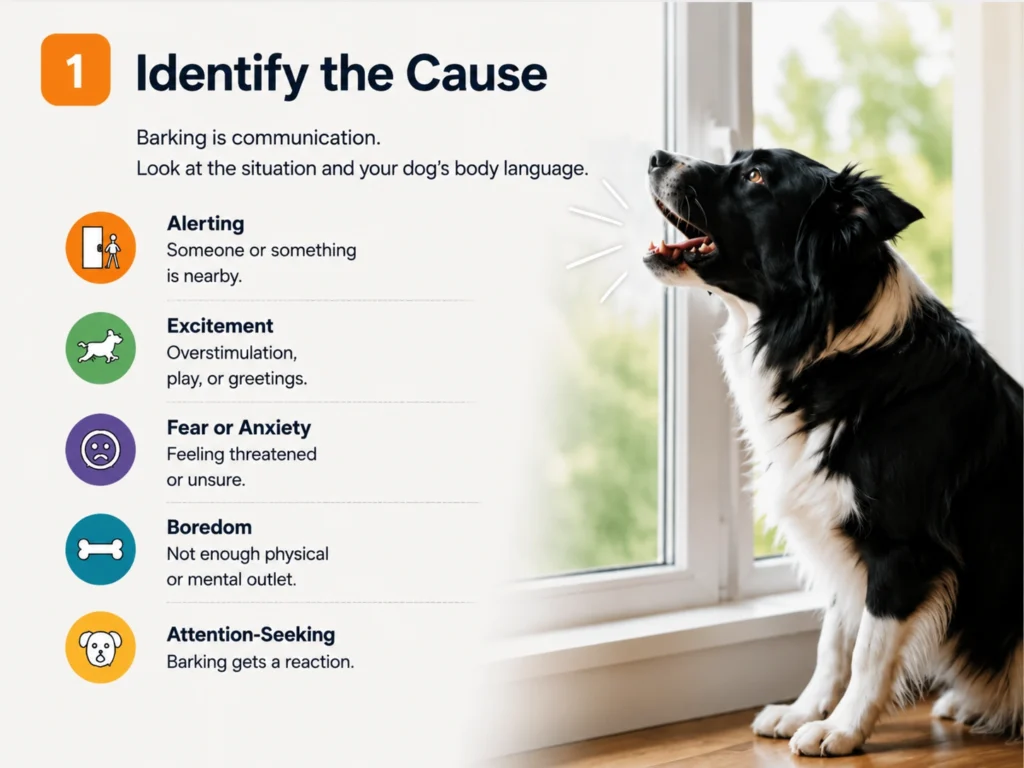
Barking Is a Normal Form of Dog Communication
Dogs use barking alongside body language and other signals. The surrounding situation matters more than the sound alone.
- Alerting: Responding to a visitor, unfamiliar sound, or change nearby.
- Excitement: Vocalizing during play, greetings, or anticipation of a walk.
- Attention seeking: Barking that has previously brought a person, toy, or interaction.
- Fear or discomfort: Trying to increase distance from a stranger, sound, or frightening situation.
Normal Barking vs. Problem Barking
A few alert barks are not necessarily a problem. Notice whether the dog can recover after the event and whether the behavior interferes with daily life.
| What to notice | Usually manageable | Worth investigating |
|---|---|---|
| Duration | Brief barking followed by settling | Prolonged or repeatedly escalating barking |
| Recovery | Returns to usual behavior after the trigger | Remains tense, restless, or distressed |
| Pattern | Predictable trigger and normal daily function | Sudden change, unclear trigger, or disrupted sleep and activity |
Does Breed Affect How Much a Dog Barks?
Some breeds were selected for work involving vocal communication. Hounds may be vocal while tracking, herding dogs may respond to movement, and terriers may alert to animals or activity. Individual dogs still vary widely, and breed alone does not explain a sudden behavior change. For a breed-specific example, read why Dachshunds bark so much.
The First Step: Find Out Why Your Dog Is Barking
Watch what happens before, during, and immediately after the barking. Note the trigger, your dog’s body language, and what happens when the trigger disappears.
- People outside the window: May involve alerting, territorial behavior, fear, or frustration.
- Left alone: Could involve boredom or separation-related distress; look for accompanying signs.
- Play or greetings: Often excitement and difficulty settling.
- Looking directly at you and barking: Could be attention seeking, but check needs first.
- New or unexplained barking: Consider discomfort, pain, sensory changes, or illness.
The same trigger can produce different responses in different dogs. If the barking is sudden, intense, or accompanied by changes in health or behavior, talk with your veterinarian before assuming it is a training issue. See the ASPCA guide to barking and its causes.
Common Types of Barking and How to Fix Them

1. How to Stop Territorial Barking
A dog may bark at people near windows, gates, or doors. Someone walking away afterward does not prove the dog deliberately caused them to leave, but repeated reactions can become a well-practiced pattern.
Action Plan:
- Reduce access to triggers: Close blinds, use window film, or move the resting spot away from a busy window.
- Teach a replacement: Practice going to a mat when the house is quiet before pairing it with a low-volume doorbell recording.
- Reward calm observation: When your dog notices a distant person and remains relaxed, mark and reward before barking begins.
2. How to Stop Attention-Seeking Barking
Some dogs learn that barking starts play or interaction. Only consider withholding attention when basic needs have been met and you have reasonably ruled out pain, fear, anxiety, and distress. Do not apply an ignoring strategy to a dog who needs to go outside, appears unwell, or is frightened.
Action Plan:
- Check for a toilet break, water, rest, exercise, and signs of discomfort before treating barking as an attention habit.
- For clearly established attention-seeking barking, briefly withhold eye contact and conversation while the barking occurs; avoid scolding.
- At the first calm pause, mark and reward, then invite a simple alternative such as sitting or resting quietly.
- Make sure the dog regularly receives attention and enrichment for calm behavior—not only after barking.
For the distinction between attention barking and other causes, see the AKC guidance on excessive barking.
3. How to Stop Boredom Barking
Some dogs bark more when they have limited opportunities for movement, exploration, social contact, or appropriate activities. Increasing enrichment can help, although it is not a substitute for treating fear or medical problems.
Action Plan:
- Offer suitable walks, sniffing time, interactive play, and opportunities to rest.
- Try food puzzles, stuffed food toys, or safe chews appropriate for your dog, and supervise as needed.
- Note when barking occurs and adjust daily activities if long periods of inactivity appear to be contributing.
4. How to Stop Separation-Related Barking
Barking during absences can reflect several causes. Separation-related distress is more concerning when barking occurs with pacing, repeated attempts to escape, drooling, trembling, destruction near exits, or toileting when left alone.
Action Plan:
- Observe before diagnosing: If practical, use a camera during a short, safe absence to note when barking begins and whether your dog can settle.
- Begin below the distress threshold: Practice departures short enough that your dog remains comfortable; this may mean only stepping out briefly.
- Increase duration carefully: Add time only while the dog remains relaxed. If distress occurs, return to a shorter, easier absence rather than forcing longer sessions.
- Get help when necessary: If your dog panics soon after you leave, injures themselves, tries to escape, or cannot tolerate even brief absences, consult a veterinarian or qualified reward-based behavior professional. Avoid repeated absences that provoke panic while seeking a plan.
Treats and enrichment can be useful for dogs who can engage with them comfortably, but a food toy alone will not resolve significant separation-related distress. See the ASPCA discussion of separation-anxiety barking.
5. How to Stop Fear-Based Barking
A dog barking at unfamiliar people or noises may be trying to create distance. Avoid forcing greetings or using punishment. The aim is to change how safe the dog feels around the trigger, not simply suppress the warning.
Action Plan: Use Desensitization & Counter-Conditioning
- Start at a safe distance: Choose a place far enough from the trigger that your dog can notice it without barking, freezing, lunging, or struggling to take food.
- Keep exposure mild: Let the dog see a distant person or hear a low-volume recording for a brief moment. Do not force the dog closer.
- Pair the trigger with rewards: As soon as the low-intensity trigger appears, offer several small, valued treats. Stop the treats when the trigger is gone.
- Repeat before progressing: Continue at the same level until your dog repeatedly stays relaxed and can voluntarily disengage, eat, and recover easily. Only then change one factor at a time, such as slightly reducing distance or raising sound volume.
- Make it easier if stress appears: If your dog barks, freezes, backs away, refuses familiar treats, or stays tense, increase distance or lower the intensity. Pause the session if they cannot recover.
Use a qualified reward-based behavior professional for intense fear, aggression, or reactions that are difficult to manage safely. The AVSAB Humane Dog Training Position Statement recommends reward-based methods for behavior problems.
6. How to Stop Excitement Barking
Dogs sometimes vocalize when highly excited about a walk, a game, or a visitor. Teach a realistic pause before the fun activity begins.
Action Plan:
- Practice with a mild version of the event, such as touching the leash without immediately leaving.
- Reward four paws on the floor and a brief quiet pause.
- Progress to opening the door or starting play only when your dog can perform the easier version calmly.
Immediate Ways to Manage Barking at Home
Management limits repeated exposure to triggers while you teach new skills. Use the options relevant to your dog rather than adding every intervention at once.
1. Block Visual Triggers
Close curtains, use privacy film, or block access to windows where passersby reliably trigger barking.
2. Set Up a Calm Resting Space
Offer a comfortable bed or mat away from busy entrances. Use a crate only if your dog already finds it safe and relaxing; do not confine a distressed dog as a quick fix.
3. Use Background Sound Buffers
A fan or gentle background sound may make sudden outdoor noises less noticeable. Keep volume comfortable and watch your dog’s response.
4. Provide Appropriate Enrichment
Sniffing games, food puzzles, licking activities, or suitable chews can give a dog something appropriate to do. These activities may support a calmer routine, but do not assume they treat the underlying cause of barking.
Effective Training Techniques That Work
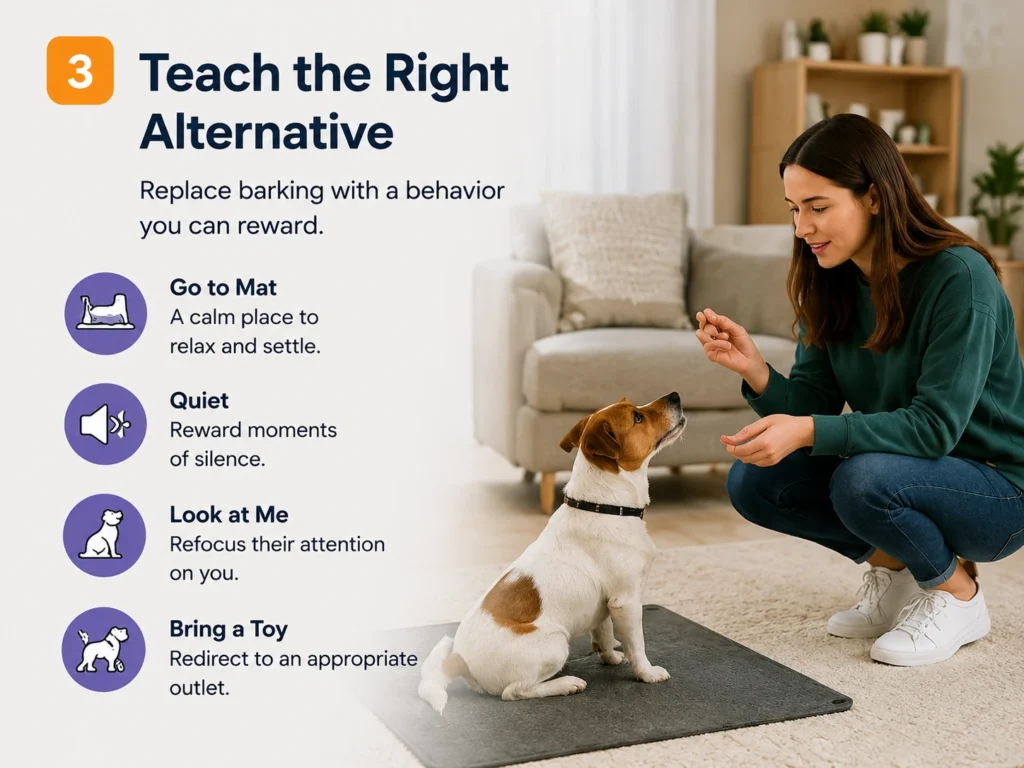
Teaching the “Quiet” Command
Teach the word after your dog understands that a brief pause earns a reward. Do not repeat “quiet” over active, escalating barking.
- Capture silence: In a low-stress setting, wait for a spontaneous pause after a mild bark. Immediately mark the silence with “yes” or a click, then deliver a treat.
- Build a small duration: Reward a brief pause consistently, then gradually wait for a slightly longer quiet interval before marking and treating.
- Add the cue: Once you can reliably predict a pause, say “quiet” just before the dog is likely to stop; mark and reward when the silence happens.
- Practice in easier situations: Repeat with mild, controllable triggers and short sessions. Increase distraction only after your dog reliably responds at the current level.
- Step back when needed: If your dog cannot stop barking or does not respond, remove or reduce the trigger rather than repeating the cue.
This sequence follows the reward-and-cue approach described by the AKC guide to teaching quiet on cue.
Rewarding Alternative Behaviors (DRA): Go to a Mat
Teach “go to your mat” away from visitors and doorbell sounds first. A mat provides a specific behavior to reward instead of barking at the door.
- Place a mat on the floor in a quiet room. When your dog approaches or steps onto it, mark immediately and give a treat on the mat.
- Reward staying on the mat briefly, then release with a consistent word such as “okay.” Keep repetitions easy and positive.
- After your dog repeatedly moves to the mat, add a cue such as “place” just before they go there. Reward after they arrive.
- Gradually build a few moments of relaxed staying, rewarding before your dog leaves. Increase duration or distance from you, but not both at once.
- When the routine is reliable, introduce a quiet doorbell sound or another mild distraction. Reward going to the mat and staying there. If your dog runs to the door or barks intensely, lower the distraction and repeat an easier step.
For a broader foundation in reinforcement and short practice sessions, see Dog Training Tips for Beginners.
Mastering Timing & Consistency
- Mark the exact behavior you want—silence, looking away from a trigger, or stepping onto the mat—and follow promptly with a reward.
- Use short, manageable sessions; stop before the dog becomes frustrated or overly aroused.
- Raise difficulty only when your dog can succeed repeatedly at the current level; a setback means the next repetition should be easier.
The Truth About Anti-Bark Tools: Do They Work?
Stopping the sound is not the same as resolving why a dog is barking. For a frightened or distressed dog, methods that add discomfort can make the underlying problem harder to manage.
Punishment-Based Tools (Shock, Spray & Ultrasonic Collars)
Avoid using aversive bark-control tools as a substitute for assessing the cause or teaching a safer response. AVSAB recommends reward-based methods and advises against aversive training methods, including electronic collars and other forms of punishment. Read the AVSAB position statements for its current guidance.
Effective Reward-Based Tools
!Infographic showing calm behavior reinforcement and gradual training progress
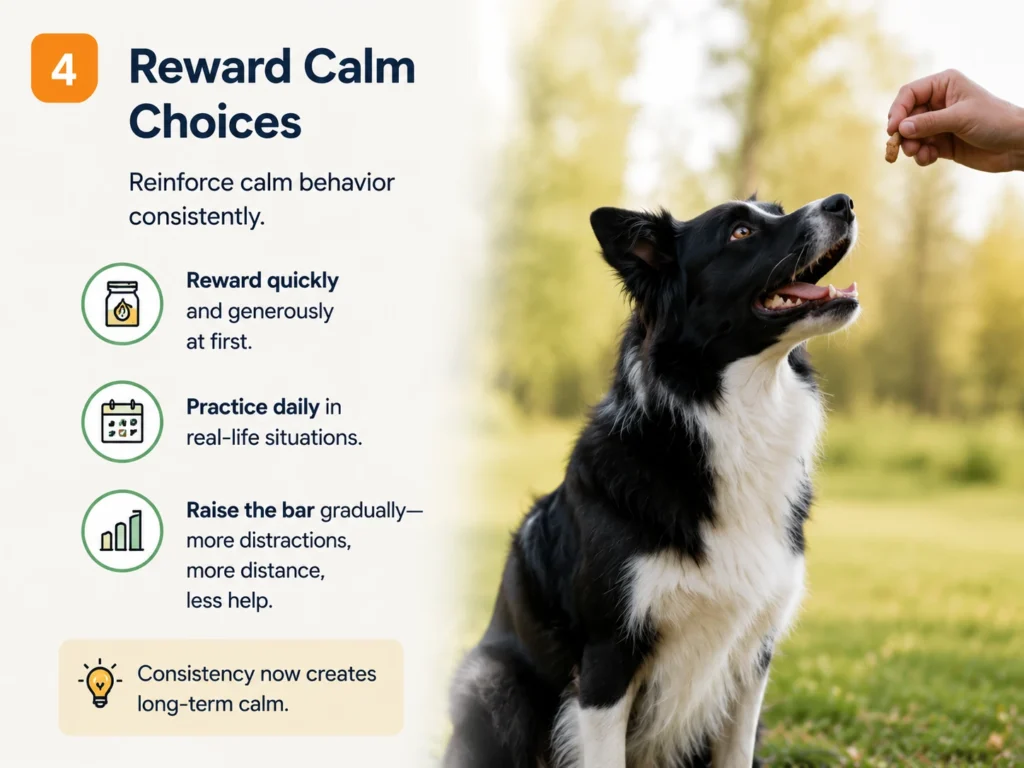
- Clicker or marker word: Helps identify the precise moment of silence or another desired behavior.
- Food rewards: Can reinforce quiet, mat behavior, and calm observation of low-intensity triggers.
- Management barriers: Curtains and gates can reduce opportunities to rehearse reactive barking.
Common Mistakes That Make Barking Worse
- Yelling over barking: Adds noise without teaching a replacement behavior.
- Ignoring every bark: Misses fear, pain, anxiety, toileting needs, and other situations where a dog needs help.
- Increasing difficulty too fast: A dog who reacts strongly is not ready for the current trigger intensity.
- Using one method for every cause: Boredom, fear, excitement, and separation-related distress require different plans.
When Barking Indicates a Medical Problem
A sudden increase in barking can accompany pain, discomfort, changes in hearing or vision, or other health problems. Seek veterinary advice if the change is new or hard to explain.
Signs to Consult Your Veterinarian:
- Sudden, frequent barking without an obvious environmental change.
- Restlessness, disorientation, or increased nighttime vocalization, particularly in an older dog.
- Changes in mobility, sleep, appetite, elimination, or signs of pain.
If you are caring for an aging dog, the Dogsoria guide to mature dog age and care covers general changes to watch for; it does not replace a veterinary assessment.
Working With Professional Trainers & Behaviorists
Seek qualified help if barking is linked to significant fear, aggression, bite risk, separation-related panic, or repeated setbacks despite appropriately easy training. A reward-based trainer can teach skills and management; a veterinarian or veterinary behaviorist can evaluate health and more complex behavior concerns. When choosing a professional, ask how they handle fearful dogs and whether they use reward-based methods.
The AVSAB guidance on choosing a trainer provides criteria for evaluating professional help.
How Long Does It Take to Stop Excessive Barking?
There is no reliable universal timetable. Improvement depends on the cause, the dog’s history, health, daily environment, and how consistently training can stay below the dog’s stress threshold. Track changes in frequency, duration, recovery time, and ability to respond to an alternative cue instead of expecting a fixed number of weeks.

Hypothetical Examples: Applying the Training Plan
The following are hypothetical illustrations, not documented Dogsoria case studies or evidence of guaranteed results.
Example 1: Window Barking in a Golden Retriever
- Situation: A dog repeatedly barks when delivery drivers pass the living-room window.
- Possible approach: Block the view when unsupervised, teach mat behavior away from the window, and reward calm observation at manageable distances.
- What to monitor: Barking frequency, ease of settling, and whether the dog can respond to the mat cue.
Example 2: Fear of Strangers During Walks
- Situation: A newly adopted dog barks and retreats when unfamiliar people approach.
- Possible approach: Increase distance immediately, introduce low-intensity observations paired with rewards, and progress only while the dog remains relaxed.
- What to monitor: Body language, recovery, willingness to eat, and whether more distance is needed.
Final Thoughts: The Goal Is Not a Silent Dog
Identify what your dog is communicating, reduce avoidable triggers, and reward a safer alternative. If your dog is frightened, in pain, or distressed when alone, address that need rather than trying to silence the barking.
Article Information
Originally published: July 2026
Written by: Luna, Founder of Dogsoria
Focus: Dog behavior education and practical home management
Medical Disclaimer
This guide is for general education, not a diagnosis or an individualized behavior treatment plan. Contact a veterinarian if barking changes suddenly or occurs with signs of pain, anxiety, aggression, or severe distress.
FAQ
Frequently asked questions
How do I get my dog to stop barking quickly?
For immediate relief, reduce the trigger when possible—for example, close the blinds or move to a quieter area. Lasting change usually requires identifying the cause and rewarding an alternative behavior.
Can you train a dog to never bark again?
Barking is a normal form of communication. A more practical goal is less frequent or shorter unwanted barking and an improved ability to settle.
Why does my dog bark at “nothing”?
Dogs may notice sounds, smells, or movement people overlook. Sudden unexplained barking, particularly with other changes in behavior, warrants a veterinary check.
Should I always ignore my dog when they bark?
No. Briefly withholding attention may help with a clearly established attention-seeking habit only after basic needs and potential pain, fear, anxiety, or distress have been addressed.
Why does my dog bark when left completely alone?
Possible explanations include frustration, boredom, and separation-related distress. Observe the absence if it is safe to do so, and seek help if barking comes with panic, escape attempts, or other distress signs.
SOURCES
Sources & scientific references
MORE FROM THIS CATEGORY