Dog Training Guide
How To Potty Train A Dachshund Puppy: A Step-by-Step Guide
Bringing home a Dachshund pu…
DOGSORIA DOG CARE GUIDE
Introduction: Helping Your Dachshund Puppy Build Good Habits
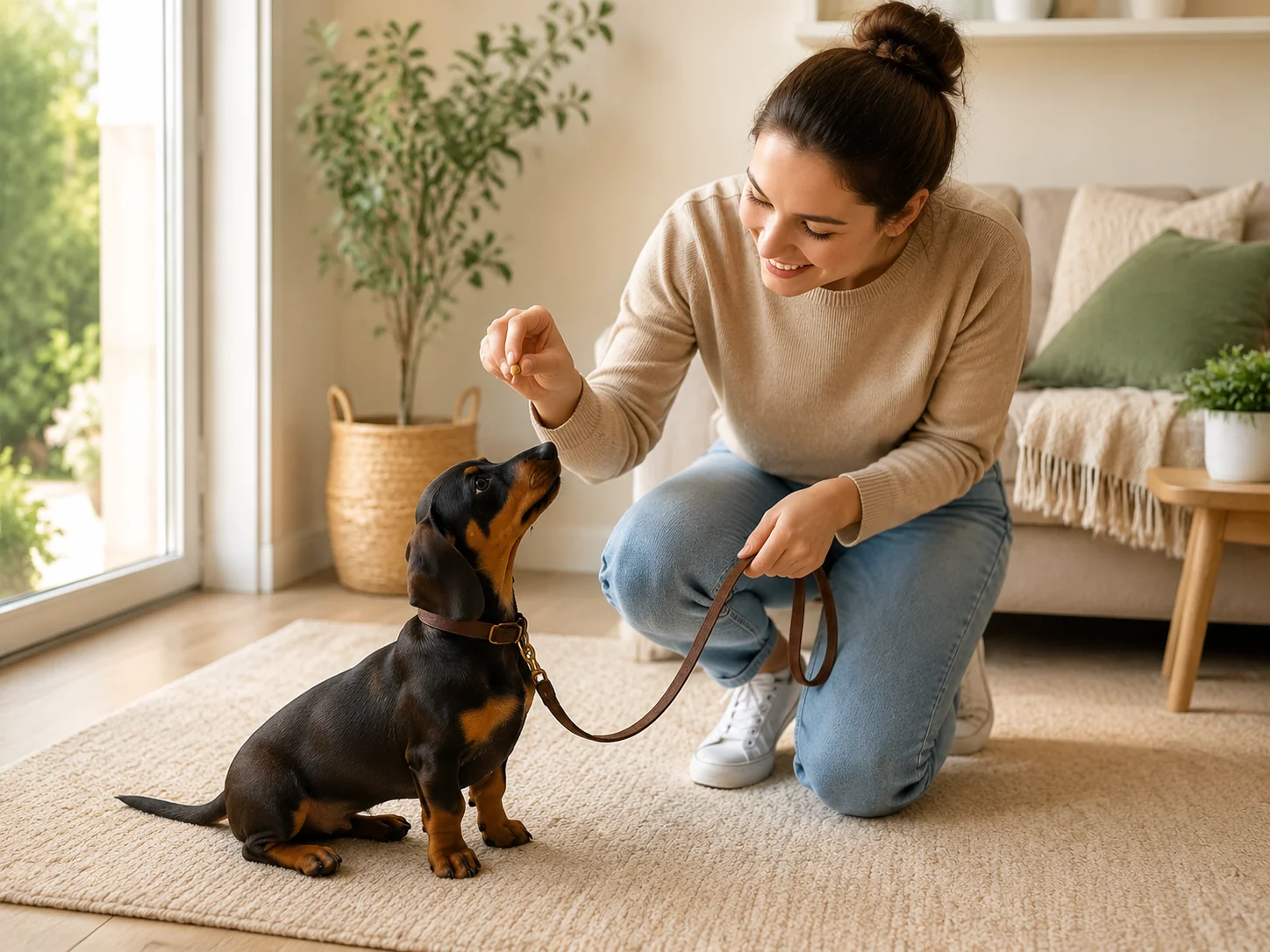
Bringing home a Dachshund puppy is one of the most exciting moments for a new dog owner. Their playful personality, funny expressions, and strong attachment to people make them incredibly lovable.
But there is one challenge almost every Dachshund owner faces: potty training.
View the detailed explanation and practical steps
Many new owners ask: “Why does my Dachshund puppy understand commands but still pee inside?”
The answer is that potty training is not only about intelligence. Dachshunds are smart dogs, but they also have unique traits that can make house training take more patience.
Their small bodies mean they have smaller bladders. Their independent personality means they may test boundaries. Their short legs and low body shape can also make cold weather, wet grass, or uncomfortable outdoor environments less appealing.
The good news? Dachshunds can absolutely become reliable house-trained companions.
Most puppies begin understanding the routine within a few weeks, but consistent potty habits usually develop over several months. The goal is not to force your puppy to “learn overnight.” The goal is to create a predictable system where your Dachshund knows:
- Where to go
- When to go
- What behavior gets rewarded
This guide will walk you through a realistic Dachshund puppy potty training plan — from the first day home to solving common problems.
Dogsoria Note: Unlike many generic puppy training articles, this guide focuses specifically on Dachshund puppies. Their body shape, personality, and lifestyle needs create challenges that are different from many larger breeds.
Why Are Dachshunds Harder To Potty Train?
Many top-ranking articles mention that Dachshunds can be challenging to potty train. However, the reason behind this difficulty is often more important than the advice itself.
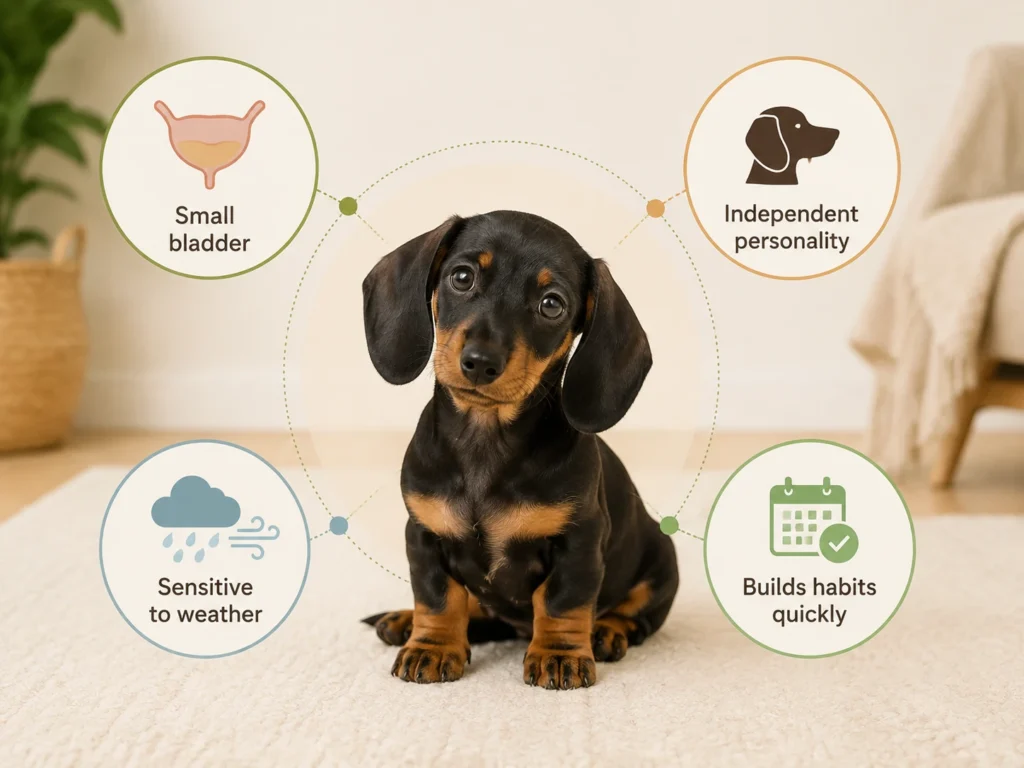
Understanding your Dachshund’s behavior makes training much easier.
View the detailed explanation and practical steps
1. Dachshunds Have Smaller Bladders
Small dogs naturally have less bladder capacity compared with larger breeds.
A young Dachshund puppy may need to go:
- Right after waking up
- After eating
- After drinking
- After playing
- After excitement
- Before bedtime
An 8-week-old puppy is not being “stubborn” when they have accidents. They may simply not have enough physical control yet.
A common mistake new owners make is expecting a young Dachshund to hold their bladder like an adult dog.
Potty training is a combination of:
- Physical development
- Routine
- Repetition
- Communication
(Not just obedience.)
2. Dachshunds Are Independent Thinkers
Dachshunds were originally bred to hunt badgers. Their job required courage, problem-solving ability, and independence. These traits are part of why people love the breed.
However, the same personality can sometimes appear during training. A Dachshund may think: “Why should I do this?”instead of immediately following instructions.
This does not mean your puppy is difficult or poorly behaved. It means your training needs to be:
- Clear
- Consistent
- Reward-based
If one family member allows indoor accidents while another does not, your puppy receives mixed information. Dachshunds learn patterns quickly — both good and bad.
3. Dachshunds Can Be Sensitive To Weather
This is a problem many Dachshund owners experience: “My puppy goes outside normally, but refuses when it rains.”
Because Dachshunds have short legs and long bodies close to the ground with less protection from cold or wet surfaces, some puppies dislike:
- Wet grass
- Cold mornings
- Strong wind
- Rainy weather
> Dogsoria Note > A potty training problem is not always a training problem. Sometimes the environment is making success harder. > A puppy that refuses to go outside during rain may need a covered potty area, a shorter route outside, or extra rewards for outdoor success.
4. Dachshunds Build Strong Habits
One thing that surprises many owners is how quickly Dachshunds learn routines. This can work in your favor.
If every morning follows: $$text{Wake up} rightarrow text{Outside} rightarrow text{Potty} rightarrow text{Reward}$$
Your puppy starts understanding the pattern. But the opposite is also true. If your puppy sometimes pees on the carpet, near the door, or in another room, they may begin seeing those places as acceptable.
Consistency is the foundation of successful potty training. Understanding these unique physical and behavioral traits across different growth stages of your Dachshund makes it much easier to stay patient through every phase of development.
—
When Should You Start Potty Training A Dachshund Puppy?
The best time to start potty training is the first day your Dachshund puppy comes home. You do not need to wait until your puppy is older.
However, expectations should match your puppy’s age. A common mistake is expecting a young puppy to behave like a trained adult dog.
| Puppy Age | What To Expect |
|---|---|
| 8 weeks | Learning the routine; accidents are completely normal |
| 10–12 weeks | Beginning to understand the potty location |
| 3–4 months | Better bladder control, but supervision is still needed |
| 5–6 months | Many puppies become much more reliable |
| 6+ months | Continue reinforcing good habits |
View the detailed explanation and practical steps
Realistic Potty Training Timeline By Age
What Does “Potty Trained” Actually Mean?
Different owners have different expectations.
For some people, potty trained means: *“My puppy knows where to go.”* For others: *“My dog can freely walk around the house without accidents.”*
These are different stages. A realistic progression looks like this:
- Stage 1: Understanding — Your Dachshund learns: *“This is where I should potty.”*
- Stage 2: Communication — Your puppy begins showing signals: waiting near the door, looking at you, whining, or walking toward the potty area.
- Stage 3: Reliability — Your Dachshund can handle more freedom without accidents.
> Dogsoria Note > A puppy having accidents does not mean training failed. It usually means the habit is not fully developed yet.
—
Prepare Your Home Before Potty Training Starts
Successful potty training starts before the first accident happens. Creating the right environment makes learning easier.
Create A Dedicated Potty Area
View the detailed explanation and practical steps
Choose one consistent location (e.g., backyard area, outdoor grass area, apartment dog relief area, or puppy pad location).
Dogs learn through repetition and association. If your puppy always goes to the same place, the environment itself becomes a signal: “This is where I go.” Avoid constantly changing locations during early training.
Prepare Essential Supplies
You do not need expensive equipment, but a few items make training much easier:
- Crate: A properly sized crate can help create structure. It should be comfortable, safe, and large enough to stand and turn around. It should never be used as punishment.
- Enzymatic Cleaner: Normal household cleaners often remove the smell for humans but not completely for dogs. If accident smells remain, your puppy may think: “This is still a bathroom spot.”An enzymatic cleaner helps remove those odor signals. While keeping your home clean, you might also want to check our guide on how much Dachshunds shed to stay ahead of indoor coat maintenance and cleanup routines.A
- Training Treats: Rewards should be small, easy to eat quickly, and exciting for your puppy. The timing matters more than the size.
Limit Freedom At The Beginning
One of the biggest mistakes new owners make is giving a puppy the entire house immediately. A young Dachshund does not understand *”living room is okay, bedroom is not.”* They only understand *”this place worked before.”*
Start with:
- A smaller puppy-safe area
- Supervised exploration
- Gradual freedom increase
—
Step-by-Step: How To Potty Train A Dachshund Puppy
Now that your routine is ready, the actual training process becomes much easier.
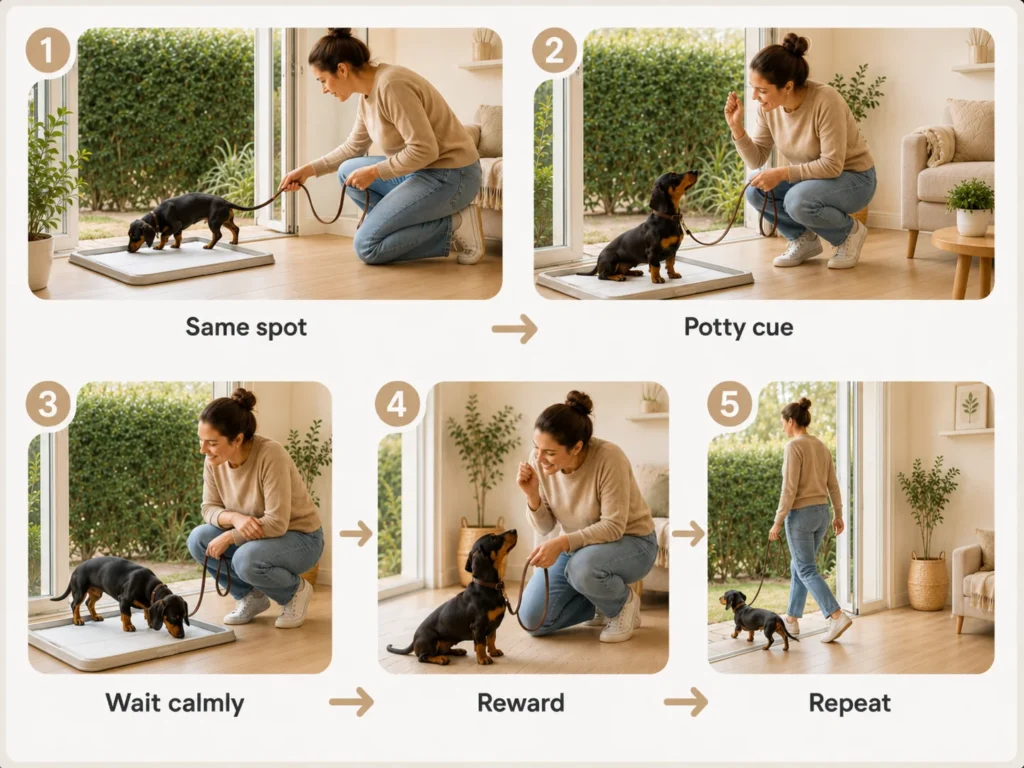
Step 1: Take Your Dachshund To The Same Potty Spot
View the detailed explanation and practical steps
Consistency helps your puppy create an association. Every time you take your puppy out, use the same area, keep the trip focused, and avoid turning potty time into a play session. The message should be clear: *“This place is for potty.”*
Step 2: Introduce A Potty Command
Choose one phrase (e.g., “Go potty”, “Bathroom”, or “Do your business”). Say the phrase calmly while your puppy is actually going. Do not repeat the command constantly. The puppy needs to connect: Word ➔ Action ➔ Reward
Step 3: Reward Immediately After Success
Many owners understand they should reward their puppy, but timing is where mistakes happen.
- Mistaken sequence: Puppy goes potty ➔ Walk back home ➔ Give treat (The delay causes confusion; the puppy thinks returning home earned the reward).
- Correct sequence: Puppy finishes potty ➔ Within seconds ➔ Reward with treat and praise (Immediate timing clearly reinforces the correct behavior)
Step 4: Supervise Indoor Time
During the early weeks, your Dachshund should not have unlimited freedom. Watch for signs: sniffing corners, moving away quietly, circling, or suddenly becoming restless. When you see these signals, do not wait — take your puppy outside immediately.
Step 5: Increase Freedom Slowly
Freedom is something your puppy earns. Increase access gradually: One puppy-safe room ➔ Two rooms with supervision ➔ Full house access
Crate Training And Potty Training
Crate training works with a dog’s natural instincts because most dogs prefer not to soil their sleeping area.
How Crate Training Helps Potty Training
View the detailed explanation and practical steps
A crate helps your puppy learn resting areas, waiting periods, and routine control while making supervision easier.
Example sequence: Wake up in crate ➔ Outside potty ➔ Reward
Important Crate Rules For Dachshunds
Dachshunds have a unique body shape. Because Dachshunds are prone to back problems such as IVDD, safe handling habits and avoiding steep jumps around crates from puppyhood are extremely important.
When choosing and using a crate, avoid:
- Excessive jumping in and out
- Very high crate entrances
- Using the crate as punishment
How Long Can A Dachshund Puppy Stay In A Crate?
- 8–10 weeks: Frequent breaks needed
- 3–4 months: Gradually increasing control
- Older puppies: Longer periods possible
First Week Potty Training Plan
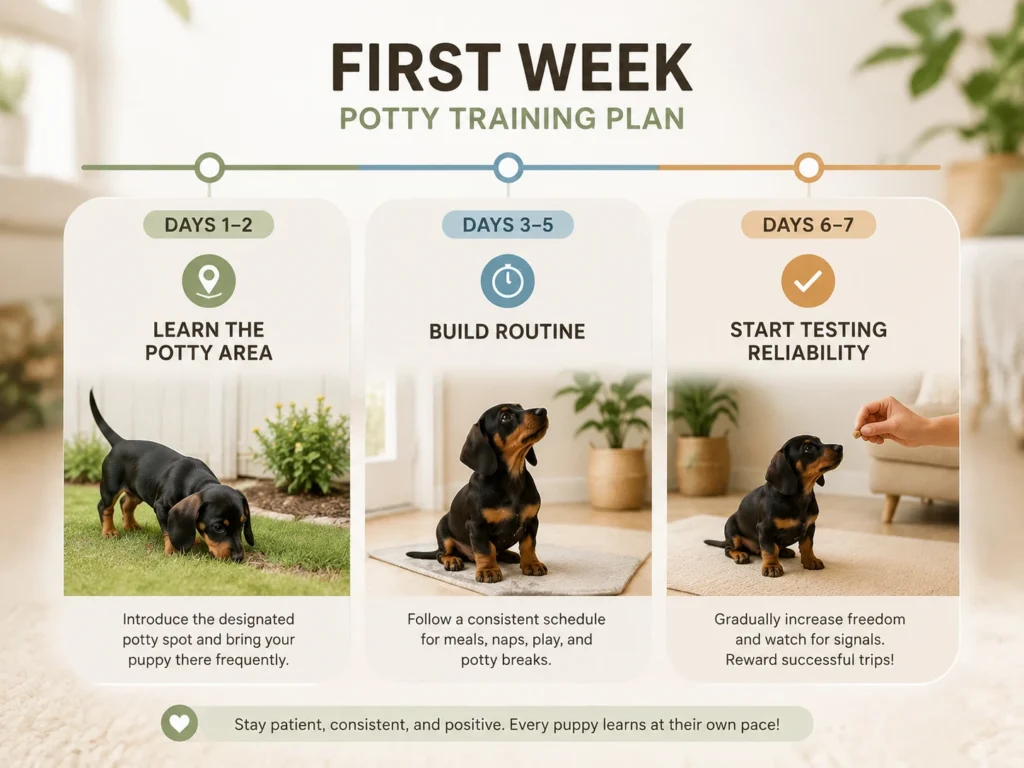
For a new Dachshund owner, the first seven days are the most confusing. Here is a realistic starting plan.
- Day 1–2: Build The Routine
- Focus on learning the potty location, taking your puppy out frequently, and rewarding every success. Do not worry about perfection; your puppy is adjusting to a new environment.
- Day 3–5: Build Communication
- Start adding the potty command, recognizing signals, and allowing slightly longer waiting periods to help your puppy understand the pattern.
- Day 6–7: Start Testing Reliability
- If accidents are decreasing, begin allowing slightly more supervised freedom.
View the detailed explanation and practical steps
Dogsoria Note : The biggest mistake new Dachshund owners make is judging progress day by day. Some days will look perfect; some days will feel like you are starting over. That is normal. Training is building a habit through repetition.
Common Dachshund Potty Training Problems And Solutions
Problem 1: My Dachshund Puppy Pees Right After Coming Inside
- Why This Happens: The puppy was too distracted outside, not given enough time, or more interested in exploring smells and people.
View the detailed explanation and practical steps
Solution: Make potty trips boring and predictable. Go to the same spot, wait patiently, avoid playing until after potty, and reward immediately. Lesson: “Outside first. Fun comes after.”
Problem 2: My Dachshund Refuses To Potty In The Rain
- Why This Happens: Their short legs mean their belly is close to wet grass, cold ground, mud, and puddles.
- Solutions:
- Create a small covered or sheltered potty area.
- Keep the routine consistent.
- Increase treat value for rainy weather success.
Problem 3: My Dachshund Was Doing Well But Started Having Accidents Again
- Possible Reasons: Routine changes, expanded freedom too quickly, stress, or medical issues. If a previously trained Dachshund suddenly has accidents, consider speaking with your veterinarian.
Problem 4: My Dachshund Only Wants To Use Puppy Pads
- Transition Strategy:
- Move the pad closer to the exit door.
- Move the pad just outside near the designated potty spot.
- Remove the pad once outdoor success becomes consistent.
Potty Training A Dachshund In An Apartment
Apartment potty training brings extra challenges: elevators, long hallways, no private yard, and bad weather.
Apartment Potty Training Tips
View the detailed explanation and practical steps
- Reduce The Distance To Success: If walking down long hallways or waiting for elevators takes too long, carry your puppy during early training.
- Have A Backup Plan: Set up a balcony grass station, indoor relief area, or puppy pads for late nights or severe storms.
- Create A Consistent Routine: Structure matters more than having a large backyard.
How To Know Your Dachshund Is Improving
Instead of asking “Is my puppy completely trained?”, look for smaller milestones.
Potty Training Progress Checklist
| Stage | Signs Of Progress |
|---|---|
| First week | Puppy recognizes the potty area |
| 2–4 weeks | Fewer random accidents |
| 1–3 months | Better communication signals |
| 4–6 months | More reliable habits |
View the detailed explanation and practical steps
Signs your Dachshund is improving:
- Goes to the correct area more often
- Has longer accident-free periods
- Begins waiting near the door
- Responds to the potty routine
- Needs fewer reminders
Common Mistakes That Slow Down Potty Training
- Punishing Accidents: Never yell or scare your puppy. They will learn to hide when they need to go. Clean calmly, review your schedule, and prevent the next accident.
- Giving Too Much Freedom Too Soon: Freedom should increase only as reliability improves.
- Inconsistent Family Rules: Everyone in the household must use the same potty spot, command, and reward system.
- Expecting Overnight Results: Potty training takes patience, repetition, and time.
How Long Does It Take To Potty Train A Dachshund Puppy?
- First Few Weeks: Puppy understands where to go and expects rewards after success.
- 3–4 Months: Noticeable improvement in bladder control and signal communication.
- 5–6 Months: Many Dachshunds become reliable, though some individual puppies take longer based on consistency and environment.
Final Thoughts From Dogsoria
Potty training a Dachshund puppy requires patience, structure, and understanding. The moments that feel frustrating are often the moments when your puppy is still learning.
Build the routine. Reward the right behavior. Stay consistent. Over time, your Dachshund will become the confident, well-trained companion you hoped for.
FAQ
Frequently asked questions
1. How long does it take to potty train a Dachshund puppy?
Many Dachshunds improve within a few months, with reliable habits often developing around 4–6 months of age.
2. Can Dachshunds be potty trained in apartments?
Yes. Apartment potty training requires more planning, but consistent schedules and proper routines work well.
3. Why does my Dachshund puppy keep peeing inside?
Common reasons include immature bladder control, inconsistent routine, too much freedom, or incomplete training.
4. How often should I take my Dachshund puppy outside?
Young puppies usually need frequent potty opportunities, especially after waking, eating, drinking, and playing.
5. Are Dachshunds harder to potty train than other dogs?
Dachshunds can sometimes take longer because of their small bladder size and independent personality. However, with consistent training, they can become reliably house-trained.se,
SOURCES
Sources & scientific references
This guide is based on trusted puppy training and Dachshund breed resources.
- American Kennel Club (AKC) — Puppy training, house training, and dog behavior guidance
https://www.akc.org/ - American Veterinary Society of Animal Behavior (AVSAB) — Science-based positive reinforcement training methods
https://avsab.org/ - VCA Animal Hospitals — Veterinary-reviewed puppy health and behavior information
https://vcahospitals.com/ - Dachshund Club of America — Dachshund breed characteristics and temperament information
https://www.dachshundclubofamerica.org/
MORE FROM THIS CATEGORY