Dog Breeds Guide
Dachshund Personality: Are They Really Good Family Dogs?
Dachshunds can be affectiona…
DOGSORIA DOG CARE GUIDE
Dachshunds can be affectionate, entertaining family dogs, but their independence, barking, prey drive, and long backs mean they fit some households better than others. This guide explains what the Dachshund personality is really like and what families should consider before bringing one home.
QUICK ANSWER
The short answer
Yes. Dachshunds can make excellent family dogs for people who want a close, entertaining companion and are willing to put some effort into training, barking management, and safe handling.
They are affectionate and funny, but they are not always effortless. Their independent streak, prey drive, tendency to bark, and long backs require more thought than their small size might suggest.
Important planning details
The American Kennel Club describes Dachshunds as intelligent, vigilant, courageous, and loving, while also noting their independence, stubbornness, and strong prey drive. AKC also suggests that they generally do especially well with older children who understand how to interact with dogs responsibly.
At-a-glance comparison
| Household | Dachshund fit |
|---|---|
| Families with older children | Very good |
| Families with toddlers | Possible with close supervision |
| Apartment households | Good if barking is managed |
| First-time dog owners | Possible, but not the easiest |
| Homes with cats | Often possible with careful introductions |
| Homes with rabbits or hamsters | More challenging |
| Families away most of the day | Often not ideal |
What Is a Dachshund’s Personality Like?
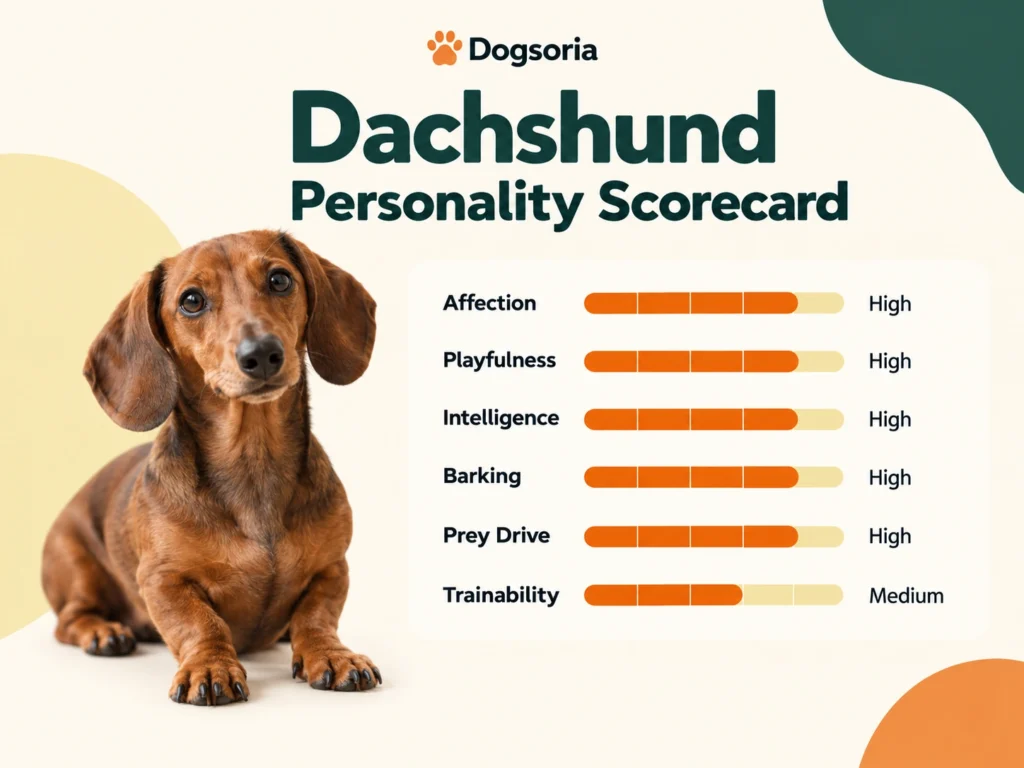
To understand why a Dachshund behaves the way it does on your living room sofa, it helps to look at what the breed was originally designed to do.
Dachshunds were developed as hunting dogs that needed enough courage and persistence to pursue quarry and enough independence to make decisions without constantly waiting for human direction. PetMD similarly describes the breed as bold, tenacious, curious, and independent.
View details for “What Is …”
That history still shows up in ordinary family life.
Curiosity becomes inspecting every new bag or smell that enters the house. Alertness becomes announcing the delivery driver before they reach the door. Persistence can become a staring contest after a command, as if the two of you are still negotiating the terms.
And intelligence? Dachshunds are smart.
They simply do not always use that intelligence to make your life easier.
These are breed tendencies, not guarantees. Genetics, early socialization, training, and individual experience all shape the dog you actually live with.
The Best Parts of the Dachshund Personality
Loyal, Affectionate, and Very Involved
Dachshunds often form strong bonds with their people. Some follow their owners from room to room, curl up beside them whenever they sit down, or develop an especially strong attachment to one person.
View details for “The Best…”
For someone who wants a small dog that genuinely feels involved in everyday family life, this is one of the breed’s biggest attractions.
And yes, many Dachshunds like to cuddle. Blankets, laps, warm couches, and suspiciously small gaps beside their humans often seem irresistible.
That does not mean every Dachshund wants to be carried or hugged constantly. Affectionate dogs still have personal boundaries.
Playful, Curious, and Full of Character
A Dachshund rarely feels like a passive lap dog.
They tend to enjoy sniffing, exploring, food puzzles, toys, burrowing under blankets, and occasionally inventing forms of entertainment nobody requested. PetMD recommends scent-based games, puzzle toys, nose work, and similar mental enrichment for the breed.
This is part of the charm: there is usually a lot of personality packed into a very long, very low package.
Brave and Alert
Many Dachshunds pay close attention to everything happening around the home.
Footsteps in the hallway, another dog outside, a doorbell, or an unfamiliar visitor can instantly become Important Dachshund Business.
That vigilance can make them surprisingly capable little watchdogs.
It also brings us to one of their most famous challenges.
The Challenging Side of Dachshund Personality
Independent Does Not Always Mean Obedient
One of the easiest mistakes to make with a Dachshund is assuming that because the dog understands a command, the dog will automatically follow it.
View details for “The Chal…”
Not necessarily.
A Dachshund can know “come” perfectly well and still decide that the squirrel across the yard deserves immediate investigation.
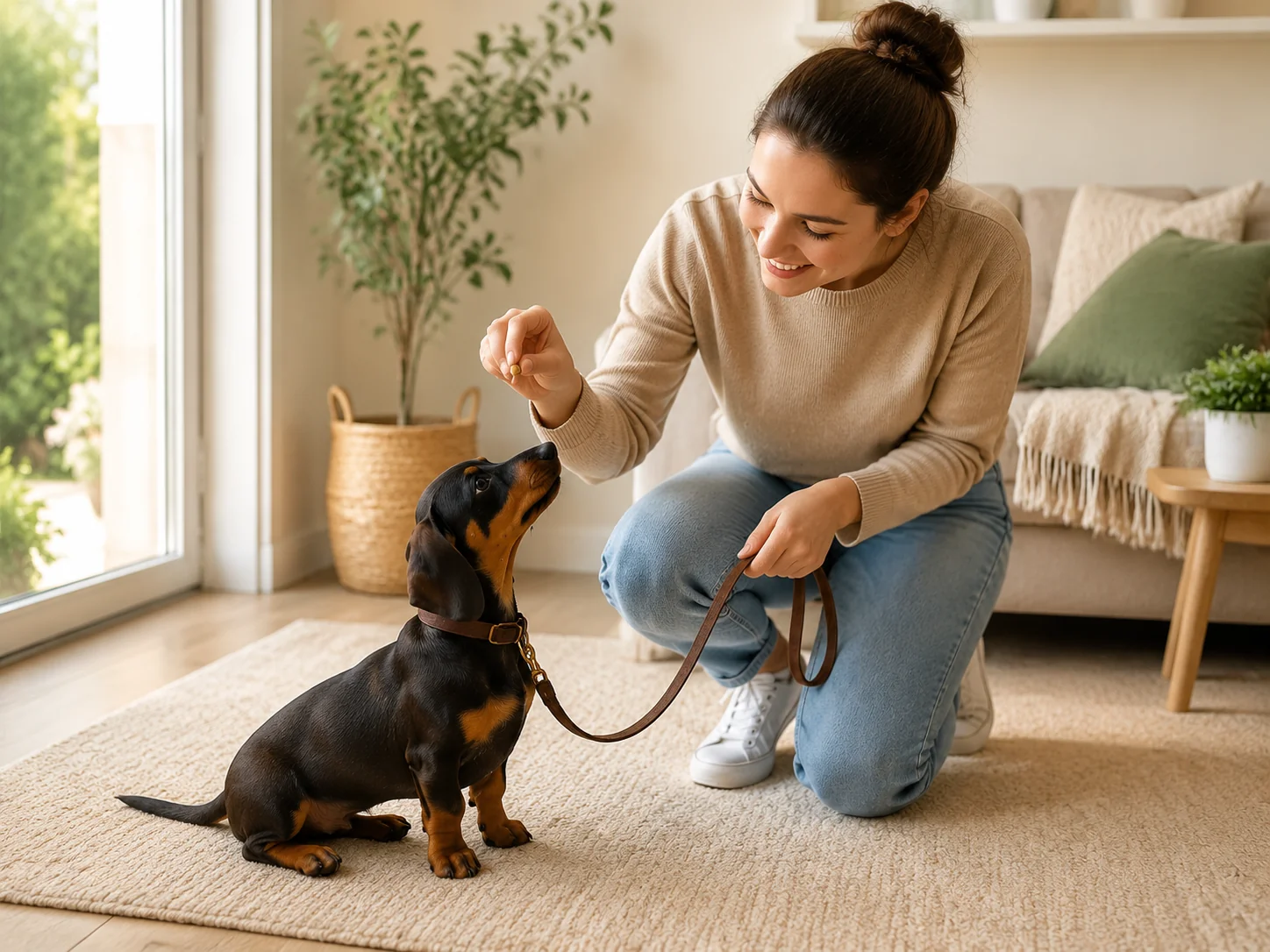
AKC notes that the breed’s intelligence and independence can make training more challenging and recommends patient, consistent, reward-based training.
Short, engaging sessions with useful rewards usually work better than long repetitive drills. Potty training can require the same patience, which is why we cover it separately in our Dachshund potty training guide.
A Big Voice in a Small Body
Dachshunds are known for being vocal.
Doorbells, hallway noises, people outside the window, dogs passing by, excitement, boredom, or simply wanting your attention can all trigger barking.
PetMD notes that Dachshunds can adapt well to apartment living while also being prone to frequent barking.
That is an important distinction.
Small enough for an apartment does not automatically mean apartment-quiet.
For many owners, the bigger question is not whether the dog fits the floor plan. It is whether they are willing to work on the soundtrack.
Their Hunting Instinct Is Still There
The Dachshund’s prey drive is not just an interesting piece of breed history. It can appear in very practical ways.
Squirrels, rabbits, birds, and other fast-moving animals may instantly capture their attention. This is also one reason owners should not assume that every Dachshund will develop reliable off-leash recall.
Many Dachshunds can live peacefully with cats, particularly when introduced carefully or raised together. But cats and tiny prey animals are not quite the same situation.
PetMD cautions that the breed’s prey drive can make homes with smaller animals more challenging.
Rabbits, hamsters, guinea pigs, and birds should be securely separated rather than relying on training alone.
Close Attachment Can Become a Challenge
Dachshunds have a reputation for being clingy, and there is some truth behind it.
Many simply like being close to their people. Following you into another room or sleeping pressed against your leg is not automatically a problem.
But affection and separation anxiety are not the same thing.
Separation anxiety involves genuine distress when left alone. A dog that has never gradually learned to spend time alone may struggle when the household suddenly disappears for an entire workday.
For families that are away for very long periods every day, this is worth thinking about before bringing a Dachshund home.
Are Dachshunds Good With Children?
They can be, but “good with kids” is far too vague to be useful.
A calm 10-year-old who understands dog boundaries is very different from a toddler who thinks hugging means climbing on top of the dog.
View details for “Are Dach…”
AKC says Dachshunds generally do best with older children who know how to interact with dogs responsibly, while PetMD recommends supervising play between Dachshunds and children.
Toddlers Need More Supervision
A Dachshund and toddler can absolutely live in the same home, but it is not necessarily the easiest pairing.
Toddlers are unpredictable. They may grab, chase, squeeze, fall onto, or try to lift a dog without understanding what they are doing.
The concern goes both ways. The child needs protection from a frightened dog reacting defensively, and the Dachshund needs protection from rough handling.
Supervision should mean an adult is actively paying attention, not simply somewhere in the same room.
Older Children Are Often an Easier Match
School-age and older children can learn not to pull ears or tails, disturb a sleeping dog, climb on the dog, or continue interacting when the dog is trying to walk away.
They can also become part of the fun by helping with reward-based training, scent games, enrichment, and walks.
That usually makes the relationship better for everyone involved.
Safety: Protecting a Dachshund’s Long Back
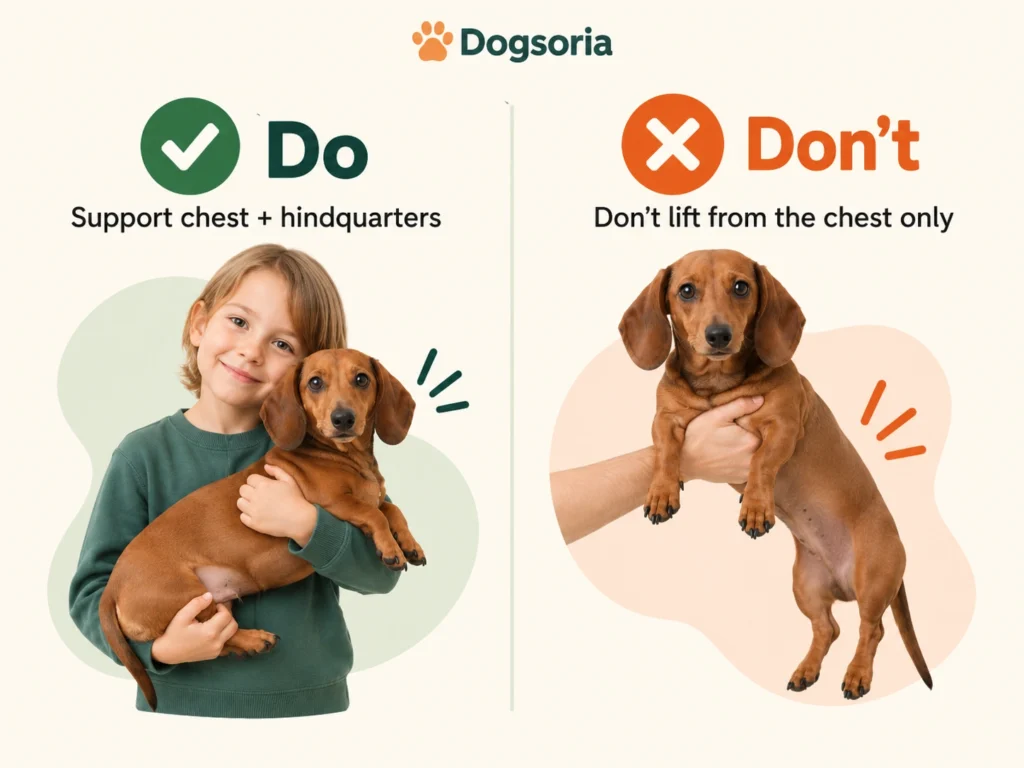
Dachshunds need special consideration because of their long spine.
PetMD identifies intervertebral disc disease, or IVDD, as an important health concern in Dachshunds, while AKC recommends reducing repeated jumping from furniture and excessive stair use.
When lifting a Dachshund, support both the front and rear of the body so the spine stays supported rather than allowing the back end to hang.
Children should not carry a Dachshund until they can do this safely and consistently.
For more detail, see our Dachshund IVDD guide.
FAQ
Frequently asked questions
1. Are Dachshunds aggressive?
Dachshunds are not automatically aggressive. Genetics, socialization, fear, learning history, environment, and individual temperament all influence behavior. Repeated growling, snapping, guarding, or biting should be treated as a behavior problem worth addressing rather than dismissed as “just a Dachshund thing.”
2. Are Dachshunds good with babies?
They can live in homes with babies and toddlers, but active adult supervision matters. As children become mobile, preventing grabbing, chasing, falling onto the dog, and unsafe lifting becomes especially important.
3. Are Dachshunds good with cats?
Many can live successfully with cats, particularly with careful introductions or when they grow up together. Their prey drive means chasing behavior should still be watched and managed.
4. Are male and female Dachshunds different in personality?
Sex alone is not a reliable personality test. Genetics, breeding line, early experiences, socialization, and training often tell you more about the individual dog than whether it is male or female.
5. Are Miniature Dachshunds different from Standard Dachshunds in personality?
There may be differences between individual dogs and breeding lines, but Miniature and Standard Dachshunds do not come with completely separate personality rulebooks. Choose the individual dog rather than relying on a size-based personality stereotype.
MORE FROM THIS CATEGORY